10 Newsletter Issue Ideas to Publish Before You Have Subscribers (2026 Playbook)

Founder and CEO of Ozigi. Writes about content strategy and the architecture of AI tools for technical creators.
TL;DR
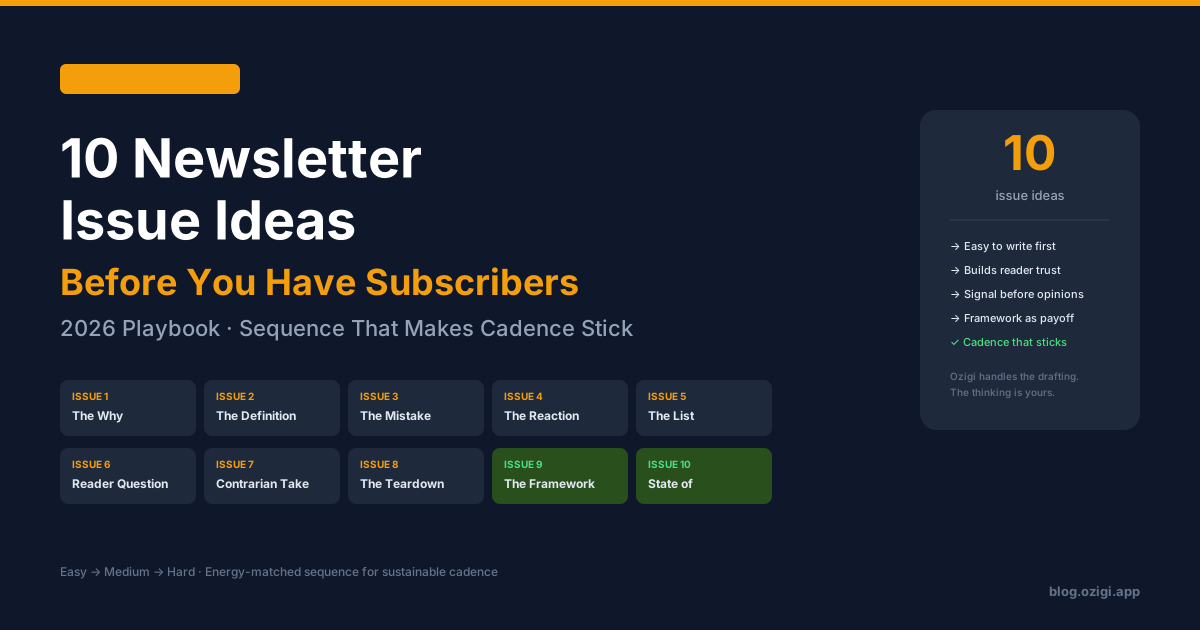
The first 10 newsletter issues are the hardest to write because you have no signal. No reader replies, no open-rate trends, no requests, no proof anyone cares. Most newsletter writers solve this by burning their best ideas in the first three issues and running out of material by issue six. This guide flips the order. The 10 issue ideas below sequence the easy-to-write content first, the relationship-building content in the middle, and the unique-perspective content later, so the cadence becomes sustainable while you build a real audience. Ozigi handles the drafting layer for each issue. The thinking and the unique angle are yours.
Why the First 10 Issues Are Different
Newsletter writers approach issue one with a stockpile of ideas and the wrong instinct about how to spend them. The instinct is to lead with the best idea, the most insight-dense piece, the one that "really shows what this newsletter is about."
This is the wrong move for two reasons.
First, you do not yet know what the newsletter is about. The newsletter discovers itself through the first 10 issues. Whatever you think it is on day one is roughly 60% accurate. The other 40% emerges from what produces engagement, what comes back as replies, and what you find yourself enjoying writing.
Second, the audience does not yet know you. They have no context, no history with your voice, no sense of what to expect. Leading with your most insight-dense piece is the equivalent of starting a first date with your most strongly held political opinion. The receiver does not yet have the relational context to absorb it.
The honest sequence for the first 10 issues treats the early issues as throat-clearing, the middle issues as relationship-building, and the later issues as bigger insight bets once you have signal about what works. This matches the energy curve documented in newsletter dropoff research and the cadence-failure patterns we covered in our how to start a newsletter guide.
The 10-Issue Sequence
The order matters. Read the full sequence before you start because each issue feeds into the next.
Issue 1: The Why (Easy to Write, Sets Foundation)
What it is: The story behind the newsletter. Why you decided to start writing about this topic, what gap you noticed in the existing coverage, what you uniquely bring to the conversation.
Why first: It is the easiest issue to write because you already know the story. It sets the foundation for everything else. It establishes the voice without the pressure of producing original insight on day one.
Format: Personal essay, 500 to 1,000 words. Not a "what to expect" boilerplate. A real story with specifics.
Avoid: Generic "I have been thinking about {topic} for years and decided to start this newsletter" prose. Show the specific moment that made you commit, the specific frustration that triggered the decision, the specific gap you saw.
Issue 2: The Definition (Easy to Write, Builds Vocabulary)
What it is: Define the central concept of the newsletter. If the newsletter is about engineering management, define what you mean by engineering management. If it is about creative writing, define what kind of creative writing.
Why second: Definitions are easy to write because they organize what you already know. They also build the shared vocabulary you will use in every future issue, so reader and writer agree on what words mean.
Format: Structured explainer, 600 to 1,200 words. Lead with your definition, contrast it with the most common alternative definition, explain why your framing matters.
Avoid: Dictionary definitions. The point is your specific framing, not the academic one.
Issue 3: The Mistake (Easy to Write, Builds Trust)
What it is: A specific mistake you made in your work, what you learned, what you would do differently. The mistake should be substantive (a real one, not a humble-brag) and the lesson should be transferable.
Why third: Vulnerability builds trust faster than expertise. A newsletter that opens with three issues of "here is what I know" reads as a content marketing operation. A newsletter that includes "here is what I got wrong" reads as a real person.
Format: First-person narrative, 600 to 1,000 words. The specific situation, the specific decision, the specific consequence, the specific lesson.
Avoid: Fake humility. A "mistake" that conveniently demonstrates how good you are at the topic. Readers smell this.
Issue 4: The Reaction (Easy to Write, Builds Topicality)
What it is: A reaction to something happening in your industry, your field, or the broader world that intersects with your topic. A news event, a new release, a viral debate, a research paper.
Why fourth: It demonstrates you are paying attention to the same things your readers are. It also creates a connection point with social media because your reaction becomes shareable.
Format: Analytical piece, 500 to 800 words. State what happened, give your specific take, explain why your take is different from the consensus.
Avoid: Hot takes without substance. The reaction should reflect your actual analysis, not your attempt to be controversial for traffic.
Issue 5: The List (Easy to Write, Boosts Engagement)
What it is: A curated list with your commentary. Could be tools, books, people to follow, articles to read, frameworks to learn. The format gives the reader concrete value while requiring less original argumentation from you.
Why fifth: By issue five, the writer is tired. Lists are forgiving to write because the structure carries most of the work. Lists also tend to be the highest-shared issue type in newsletters, according to Beehiiv's analysis of 15.68 billion sends.
Format: 10 to 20 items with one to three sentences of commentary per item. 800 to 1,200 words total.
Avoid: Lists that are just links without commentary. The commentary is the differentiation.
Issue 6: The Reader Question (Medium Difficulty, Builds Community)
What it is: An issue that responds to a question you received from a reader, or a question you would expect to receive if you had more subscribers. Frame it explicitly as a response.
Why sixth: By issue six, you have probably received at least one or two reader replies. This issue rewards them and signals to other readers that replies get attention. If you have not received any replies yet, frame the issue around a question you encountered in your own work or in industry conversations.
Format: Question-and-answer, 500 to 900 words. State the question, give your thinking, explain the reasoning.
Avoid: Inventing fake reader questions. If you have no real ones, frame the question honestly as one you have encountered, not one a fictional subscriber asked.
Issue 7: The Contrarian Take (Harder to Write, Differentiates the Newsletter)
What it is: A position you hold that disagrees with the consensus in your field. The position should be defensible (you can make the case) and substantive (it would matter if you are right).
Why seventh: By issue seven, you have established voice, vocabulary, and trust. The audience is ready to absorb a stronger opinion. Earlier than this, the contrarian take lacks the foundation to land.
Format: Argumentative essay, 800 to 1,400 words. State the consensus, state your disagreement, give your reasoning, address the strongest counter-argument.
Avoid: Performative contrarianism. The disagreement should reflect your actual belief, not an attempt to seem provocative.
Issue 8: The Teardown (Harder to Write, Demonstrates Expertise)
What it is: A detailed analysis of a specific piece of work in your field. A campaign teardown, a code teardown, a strategy teardown, a writing teardown. Pick something real, name it, analyze it specifically.
Why eighth: Teardowns demonstrate expertise in a way that abstract discussion cannot. The specificity of the example forces you to apply your framework to real-world material.
Format: Structured analysis, 1,000 to 1,800 words. The artifact, the context, the specific elements you are analyzing, the takeaways.
Avoid: Teardowns that are obvious praise or obvious dunking. The interesting teardown finds the specific elements that work and the specific elements that do not, in the same piece of work.
Issue 9: The Framework (Hardest to Write, Highest Impact)
What it is: An original framework or mental model you use in your own work. Could be a decision matrix, a sequence, a checklist, a way of categorizing decisions in your field.
Why ninth: By issue nine, you have the voice and vocabulary to introduce something new. Frameworks are the highest-impact issue type because they are the most repeatedly useful, the most quoted, and the most likely to become the thing your newsletter is known for. Look at the most successful newsletters in any category and you will find that the frameworks they introduced (Lenny Rachitsky's growth loops, Sahil Bloom's mental models) became the spine of their long-term audience growth.
Format: Structured explainer, 1,200 to 2,000 words. The problem the framework solves, the framework itself, examples of applying it.
Avoid: Frameworks that are just rebrandings of existing frameworks. The framework should be something you have actually developed through your own work, not a renamed version of someone else's.
Issue 10: The State of (Easy to Write, Closes the Loop)
What it is: A "state of {topic}" issue that synthesizes what is happening in your field right now, what is changing, what to watch. Often best published at the end of a quarter or year.
Why tenth: By issue 10, you have established credibility to make broad claims about the field. The "state of" issue is also the easiest to share on social media because it doubles as a reference document.
Format: Synthesis piece, 1,500 to 2,500 words. The current state, the changes happening, your predictions for what comes next.
Avoid: "State of" issues that are just collections of news items. The point is your analysis of the patterns, not a recap of events.
Why This Sequence Works Better Than the Standard Advice
The standard newsletter advice is "write what you know about" and "be consistent." Both true and both useless. The harder questions are which specific topics, in what order, at what length.
The sequence above solves three problems standard advice ignores.
It manages the writer's energy. Issue one to five are the easier-to-write issues, which matches the actual energy curve of a new newsletter. The first issue gets all the attention. By issue four, most writers are tired. Putting the harder issues later in the sequence means you are not burning out on the harder writing during the cadence-establishment phase.
It builds the reader relationship before asking for trust. The vulnerability of the mistake issue (issue 3) builds trust before the contrarian take (issue 7) asks the reader to accept a strong opinion. The reverse order produces churn.
It generates signal incrementally. By issue six, you have seen which content types produce replies, which subject lines work, which topics drive shares. Issues seven through 10 can be calibrated against that signal rather than guessed at.
How to Use Ozigi for the First 10 Issues
The blank-page problem is real and it hits hardest in the first 10 issues because the cadence has not yet become habit.
A faster workflow per issue:
- Spend 20 to 30 minutes capturing raw material: links you saved during the week, notes from conversations, screenshots, transcripts, the half-formed argument you have been turning over.
- Open Ozigi's free newsletter generator and drop the raw material in. URLs work. PDFs work. Pasted notes work.
- Generate the draft shaped by your persona. The voice is yours from the first issue, which means the newsletter sounds consistent from issue one rather than finding its voice by issue six.
- Edit the personal angle in. The story, the specific example, the reader-relevant detail.
- Run through grammar and readability tools (LanguageTool, Hemingway Editor) before sending.
Total time per issue with a stocked swipe file: under two hours. Compare to the four-to-six-hour issue most new newsletter writers produce when starting from blank.
The honest constraint: AI compresses the drafting step, not the thinking step. The 10-issue sequence works because you bring real material to each issue, not because the tool generates the substance for you.
Where to Send Your First 10 Issues
The free ESP options that work for a brand-new newsletter in 2026:
- Beehiiv Launch (free, 2,500 subscribers): the strongest publisher-focused free tier
- EmailOctopus (free, 2,500 subscribers): generous limits with basic automation
- MailerLite (free, 500 subscribers): the most feature-dense free tier at small scale
- Buttondown (free, 100 subscribers): Markdown-first for technical writers
- Kit (free, 10,000 subscribers): highest subscriber cap, broadcasts only on free plan
- Substack (free unless monetized, 10% cut on paid subs): built-in discovery network
For the first 10 issues specifically, the platform matters less than the cadence. Pick one, commit to it for at least 10 issues, then evaluate. Migration between ESPs is straightforward via CSV export.
What to Do After Issue 10
By issue 10, the newsletter has revealed itself. You know which content types produce engagement, which topics drive shares, which voice elements land with readers. The next 10 issues should double down on what worked in the first 10 and discard what did not.
Common patterns:
- If reaction issues drove engagement: more reactions, less abstract analysis.
- If teardowns drove engagement: more teardowns, fewer think-pieces.
- If reader questions drove engagement: explicitly invite more questions and build issues around them.
- If the framework issue drove engagement: the framework probably becomes the spine of the next 20 issues.
The newsletter that ends up working 18 months from now is almost never the newsletter you launched. The first 10 issues are the discovery period. Optimize for sustainability and signal-gathering, not for perfection.
For repurposing each issue into social content (which compounds the audience growth flywheel), see our newsletter repurposing workflow guide.
FAQ
How long should each of the first 10 newsletter issues be? Between 500 and 2,500 words depending on the issue type. The sequence above includes specific length targets per issue. Shorter is generally better for early issues to keep the writing cadence sustainable.
How often should I publish in the first 10 issues? Weekly is the standard and the easiest to maintain because the gap between issues is short enough that readers do not forget you. Biweekly works for newsletters with deeper analysis. Monthly is too slow for cadence-establishment because the audience cannot form a habit.
Should I write all 10 issues in advance before launching? No. Two to three issues drafted in advance is the right buffer. More than that and you over-optimize for issues that will not match what the audience actually wants. The cadence is the engine, and the engine only starts when you publish.
What if I have no subscribers when I start? Publish anyway. The first 10 issues serve two purposes: they build the cadence and they create the body of work that proves to future subscribers the newsletter is real. Writers who wait for subscribers before publishing never start.
Should the first issue be the "best" issue? No. The best issue should arrive around issue seven or nine, after the voice has settled and the audience has formed expectations. The first issue should be authentic and clear, not exceptional.
Can Ozigi generate the first 10 issues for me? Ozigi generates first drafts shaped by your persona and your raw material. The thinking, the specific story, the unique angle still come from you. The 10-issue sequence works because you bring real substance to each issue, not because the tool produces substance from nothing.
What if I run out of ideas before issue 10? The most likely cause is the topic is too broad or you do not have enough raw material in your swipe file. Narrow the topic and spend more time capturing material between issues. The 10-issue sequence covers most content types, so running out of ideas usually signals a positioning problem, not an ideas problem.
Is the Ozigi codebase open source? Yes, on GitHub at Ozigi-app/OziGi. The persona system and content generation flow are documented on the Ozigi blog.
This article was generated and refined on Ozigi. Try the free newsletter generator yourself — no signup required.
About the author
Founder and CEO of Ozigi. Writes about content strategy and the architecture of AI tools for technical creators.