Rytr vs Ozigi: An Honest 2026 Comparison for Human-Sounding AI Content

Founder and CEO of Ozigi. Writes about content strategy and the architecture of AI tools for technical creators.
Choosing between Rytr and Ozigi comes down to one question: do you want fast templates, or content that carries your own voice? Rytr is a general-purpose template writer used by millions for quick copy. Ozigi learns your voice from raw material you already created, then enforces a banned-word list that strips robotic phrasing before you publish.
Table of Contents
- How We Evaluated Human-Sounding AI Writing Tools
- Side-by-Side: Rytr vs Ozigi Feature Comparison
- What Makes AI Sound Human vs Robotic?
- When to Choose Rytr vs Ozigi
- Common Mistakes When Choosing Between AI Writing Tools
- Pricing: Ozigi's Tiers vs Rytr's Public Plans
- Why Ozigi Prioritizes Voice Preservation Over Template Generation
Rytr vs Ozigi: The Headline Difference in Human-Sounding AI Writing
Both tools want to produce writing that reads like a person made it. They take very different routes to get there.
Rytr is a free, template-driven AI writer. It generates emails, SEO meta titles, review replies, and post ideas from a tone or category you pick. Its positioning is plain: original content that sounds like you, not a robot, trusted by more than 8 million writers, marketers, and entrepreneurs.
Ozigi starts from the opposite end. Instead of a blank template, you hand it raw material: a URL, meeting notes, a PDF, a voice note, an image, or a video. The engine reads your existing vocabulary, sentence rhythm, and point of view, then drafts something that sounds like you wrote it. Our multimodal ingestion pipeline handles the extraction, so you do not have to clean anything up first.
Ozigi runs on Google Gemini via Vertex AI, which lets us apply hard constraints like the banned lexicon at generation time. Rytr uses its own proprietary models tuned for fast, template-based output.
What Is the Core Difference Between Rytr and Ozigi?
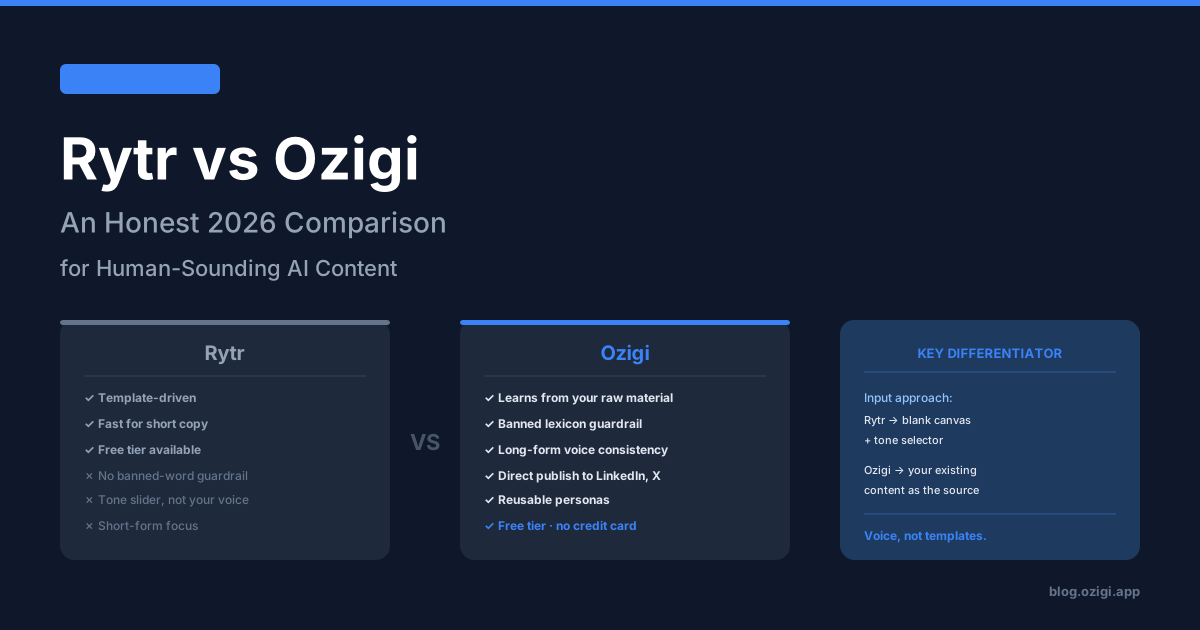
Input approach. Rytr begins with a blank canvas and a tone selector. Ozigi begins with something you already wrote and builds outward from it. Because Ozigi reads your raw material instead of guessing, the draft carries more of your actual phrasing.
How We Evaluated Human-Sounding AI Writing Tools
We put both tools through the same real jobs: blog posts, LinkedIn updates, X threads, email newsletters, and short technical briefs. Five criteria mattered most.
Voice preservation. Does the output match your natural style, or a generic brand voice? We fed each tool an existing blog excerpt and asked for a new piece on the same topic.
AI cliche avoidance. We watched for overused tells like "delve," "leverage," "robust," and "game-changer." The fewer, the better.
Long-form coherence. Voice has to hold over 1,000 words and beyond. We checked whether each tool kept a consistent style and avoided repetitive sentence shapes across a long guide.
Platform-specific formatting. LinkedIn wants a professional tone with line breaks. X threads want short, punchy lines. We graded how much manual reformatting each tool needed.
Workflow efficiency. Time from input to a draft you would actually publish, edits included.
We also kept an eye on the regulatory picture. The Federal Trade Commission has scrutinized AI-generated content that imitates real reviews, and its guidance on AI tools is worth reading before you build a workflow around any generator.
How Can You Tell If AI Content Sounds Human?
Read it out loud. Human writing varies sentence length, drops in a specific example, and avoids predictable transitions. AI writing drifts toward uniform rhythm and filler openers. In language-model terms, human text has higher burstiness, the natural variation in sentence length that flat AI output lacks.
What Criteria Matter Most in an AI Writing Tool?
It depends on the job. For short captions or quick replies, voice preservation matters less. For long-form posts that carry your name or brand, it is the whole game. We weight voice preservation and cliche avoidance highest for content creators and marketers.
Side-by-Side: Rytr vs Ozigi Feature Comparison
| Feature | Rytr | Ozigi |
|---|---|---|
| Voice Preservation | Based on tone selection and templates. Limited ability to learn your existing writing style. | Learns from raw material input (URLs, meeting notes, PDFs, voice notes, images, video). Matches your vocabulary and rhythm. |
| AI Cliche Avoidance | No built-in guardrail for AI-sounding phrases. Output can carry overused buzzwords. | Banned lexicon guardrail flags and replaces phrases like "delve" or "leverage" before publication. |
| Long-Form Coherence | Built for short-form copy (emails, meta descriptions, captions). Long pieces need multiple prompts. | Native long-form generation for blog posts, technical docs, and newsletters. Holds voice past 1,000 words. |
| Platform-Specific Output | Standard text output. Formatting for LinkedIn, X, or email is largely manual. | Direct publishing to X, LinkedIn, Discord, and Slack, with platform-native formatting. |
| Workflow Efficiency | Fast start for small tasks. Free tier with basic features. | Input analysis adds a little time per generation, but the draft lands closer to final, so you edit less. |
| Pricing | Public plans: Free $0; Unlimited about $7.50/mo; Premium about $24.16/mo (annual billing). | Free $0 (5 campaigns/mo); Team $15/mo (30 campaigns); Organization $39/mo (unlimited); Enterprise custom. |
Table notes: Ozigi pricing and features are from our own pricing page. Rytr pricing is taken from rytr.me as of May 2026; monthly billing runs higher than the annual rates shown.
What Makes AI Sound Human vs Robotic?
Human writing has texture. It varies sentence length, avoids predictable transitions, and includes the writer's perspective and concrete examples.
Language models, left alone, gravitate toward the statistical mean. They pick the most likely next word, which is how you end up with "it is important to note" and "in today's world." Those patterns make text feel flat and corporate.
Tools that rely purely on tone templates struggle to escape that pull, because the model does not know who you are or how you talk.
Ozigi feeds the model your actual material. When it reads your past posts, it picks up your phrase preferences, your paragraphing habits, and your usual sentence openers. The output then reflects your voice instead of the average of the internet.
Why Do Some AI Tools Sound Robotic?
Two reasons: model behavior and missing constraints. General-purpose models trained on huge datasets cannot tell your voice apart from the average voice. And without a hard rule against cliche phrases, the model defaults to the most statistically common wording. That is why so many AI articles read the same.
When to Choose Rytr vs Ozigi
Rytr excels at lightweight, template-driven tasks. Need quick email copy, an SEO meta description, or a short caption? Rytr is fast, the barrier to entry is low, and the free plan lets you start without setup. Speed and simplicity are its strengths.
Ozigi excels at voice-consistent, long-form content. If you run a blog, send a newsletter, or publish technical docs, Ozigi saves hours of editing. Direct publishing to X, LinkedIn, Discord, and Slack means you can generate and post in one flow without reformatting.
When Should You Pick Rytr?
Pick Rytr when you need a fast, free starting point for small tasks: standard emails, review replies, and basic captions. If a unique brand voice is not the priority, its template library is convenient.
When Does Ozigi Make More Sense?
Choose Ozigi when the content represents you. Blog posts, newsletters, LinkedIn thought leadership, and client-facing guides all benefit from voice preservation. Raw material input also turns meeting notes into polished updates fast. Try the free long-form article generator to see it on a real draft, no signup required. For longform specifically, our comparison against Jasper, Copy.ai, and Writesonic goes deeper on that use case.
Common Mistakes When Choosing Between AI Writing Tools
The most common mistake is assuming every AI writer produces the same quality of human-sounding output, then picking on price alone and paying for it later in editing time.
A subtler mistake is ignoring how the tool handles input. Template-only models force your content into a generic shape. Input-based tools learn from what you already wrote.
It is also worth understanding the regulatory backdrop without overstating it. In 2024 the FTC approved a final order against Rytr over a feature it said could generate deceptive reviews. In December 2025 the FTC reopened and set that order aside, finding the original complaint did not meet the FTC Act's requirements. The takeaway is not that one tool is tainted. It is that authentic, non-deceptive output is the safer long-term posture for any creator, whichever tool you use.
Finally, look for built-in quality guardrails. Ozigi's banned lexicon flags and replaces AI cliches automatically. We wrote up how we catch AI slop in production if you want the technical version.
What Is the Biggest Mistake People Make When Choosing an AI Writer?
Picking on template count instead of voice. A hundred templates still produce generic output if the tool does not know how you write. For anything published under your name, voice preservation should lead.
Pricing: Ozigi's Tiers vs Rytr's Public Plans
Both tools publish their pricing. Rytr lists a free plan plus paid tiers: Unlimited at about $7.50 per month and Premium at about $24.16 per month when billed annually. Ozigi publishes four tiers.
| Plan | Monthly Price | Campaigns | Personas | Key Features |
|---|---|---|---|---|
| Free | $0 | 5 | 1 | X, LinkedIn, Discord publishing |
| Team | $15 | 30 | Unlimited | Image gen (2/campaign), email newsletter, scheduling |
| Organization | $39 | Unlimited | Unlimited | Slack, unlimited image gen, long-form, Ozigi Copilot |
| Enterprise | Custom | Custom | Custom | Dedicated onboarding, SLA, white-label option |
Both tools start free. Rytr's free plan is a quick on-ramp for small tasks. Ozigi's free tier includes voice preservation and the banned lexicon from day one, capped at 5 campaigns a month. See the full pricing breakdown for current limits.
How Does Ozigi's Pricing Compare to Rytr?
Rytr is cheaper at the entry paid tier and built for high-volume short copy. Ozigi's Team plan at $15 per month adds 30 campaigns, unlimited personas, image generation, and newsletter sending, aimed at creators who publish regularly and care about voice. Different jobs, different value.
Why Ozigi Prioritizes Voice Preservation Over Template Generation
We built Ozigi around a single problem: readers can tell when content was written by AI, and that erodes trust.
The approach is direct. You drop in raw material, a link to your last post, a meeting transcript, a voice note, a PDF of internal docs. The engine processes it, then learns your sentence structure, your go-to phrases, and your tone.
Before generation even starts, we apply the banned lexicon. If the model reaches for "delve," "leverage," or "tapestry," the engine catches it and finds direct phrasing instead. That raises the burstiness of the output, so the result reads like a person wrote it.
We also store reusable personas, so you can switch brand voices across clients or projects without starting over. And a human-in-the-loop step means nothing publishes without your review.
Full automation produces forgettable content at scale. Ozigi follows a 90/10 split: the engine handles ingestion, extraction, and drafting, and you add the specifics only you know.
How Does Ozigi Preserve Your Voice?
The raw material is the key. When you submit a URL, PDF, or voice note, Ozigi extracts stylistic patterns: average sentence length, preferred transitions, typical paragraph depth. That profile tells the model how to write as you. Each saved persona stores a voice profile you can reuse. Set one up at the personas marketplace to get started.
Why Does Voice Preservation Matter for AI Content?
Generic AI content damages credibility. When every paragraph opens with a filler phrase or leans on "leverage," readers quietly label it machine-written and click away. Voice preservation keeps the writing recognizably yours, because the raw material was.
Frequently Asked Questions About Rytr vs Ozigi
Is Rytr or Ozigi better for long-form content? Ozigi is built for long-form, with raw material input and persona management that hold your voice across a 1,500-word piece. Rytr is stronger for short-form templates: emails, meta descriptions, and captions.
Does Ozigi have a free plan? Yes. Ozigi's Free tier costs $0 and includes 5 campaigns per month, 1 saved persona, and publishing to X, LinkedIn, and Discord. Image generation, email newsletters, and the Copilot are paid features.
What happened with the FTC and Rytr? In 2024 the FTC approved a final order against Rytr tied to an AI review-generation feature it said could produce deceptive testimonials. In December 2025 the FTC reopened and set that order aside, finding the original complaint fell short of the FTC Act's requirements. Both releases are public on ftc.gov.
Can Ozigi write in my personal voice? Yes. Ozigi learns your voice from existing content: URLs, meeting notes, PDFs, voice notes, images, or video. The more you feed it, the closer it matches your vocabulary and rhythm. It does not rely on generic tone sliders.
Which tool is more affordable? Both start free. Rytr's paid plans run about $7.50 per month (Unlimited) and $24.16 per month (Premium) billed annually. Ozigi's paid plans start at $15 per month for the Team tier, which adds 30 campaigns and unlimited personas. The cheaper option depends on whether you need short copy at volume or voice-consistent longform.
Try the free long-form article generator to compare the output yourself — no signup required.
About the author
Founder and CEO of Ozigi. Writes about content strategy and the architecture of AI tools for technical creators.