How to Turn 1 Newsletter Into 7 Days of Social Content (2026 Repurposing Workflow)

Founder and CEO of Ozigi. Writes about content strategy and the architecture of AI tools for technical creators.
TL;DR
Most newsletter writers do the hard work (writing the issue) and then leave the easy work (the social repurposing) on the table. The newsletter takes three to five hours to produce. The repurposing into a week of X posts, LinkedIn posts, Slack drops, and Discord announcements would take another two hours if done manually. Most writers do not have the second two hours. This guide shows how to compress that second step into 15 minutes, so one newsletter becomes seven days of social content without sacrificing voice. Ozigi handles the mechanical part. The strategic decisions are yours.
Haven't written the newsletter yet? Ozigi's free newsletter generator drafts the issue first — the repurposing workflow below picks up from there.
The Math That Makes Repurposing Worth It
A newsletter writer publishing weekly produces 50 newsletter issues per year. Each issue takes roughly four hours from idea to sent. Total annual investment: 200 hours.
The same 50 issues, if repurposed into social content, generate roughly 350 social posts per year (seven per issue across LinkedIn, X, and one community channel). Without repurposing, the writer produces zero net social content. With repurposing, the writer produces enough social content to maintain a consistent presence across the platforms where new subscribers come from.
The repurposing math compounds. Each social post drives newsletter subscribers. Each new subscriber compounds the value of every future newsletter issue. The writers who never repurpose are leaving the audience-growth flywheel disconnected from the content engine.
The reason most writers skip the repurposing is not strategic. It is logistical. After four hours of writing the newsletter, almost no one wants to spend another two hours rewriting it into social variations. The workflow has to be faster than that or the repurposing does not happen.
What Does Not Work: The Standard Repurposing Advice
The standard advice is "pull out three quotes from the newsletter and turn them into tweets." This advice is wrong for two reasons.
The first reason is that tweets are not the same format as newsletter prose. A sentence that works inside a 1,200-word newsletter does not work as a standalone tweet because tweets need different scaffolding (a hook, a payoff, a reason to scroll back). Copy-pasting a sentence from your newsletter into X usually produces something that reads as a fragment.
The second reason is that the standard advice ignores platform-specific dynamics. LinkedIn rewards different content than X. Long-form LinkedIn posts (1,200 to 1,500 characters) outperform short ones in 2026. X threads outperform single tweets for serious content. Slack and Discord drops have different conventions entirely. Treating "social content" as one undifferentiated category produces mediocre output on every platform.
A real repurposing workflow treats each platform as a separate format with its own conventions and asks the AI to do the format translation, not just the text extraction.
The 7-Day Repurposing Map
One newsletter issue produces this week of social content:
Day 1 (newsletter publish day): Newsletter goes out. A LinkedIn post announces the issue with the key argument plus a "read the full breakdown" link. An X post does the same, optimized for the X format.
Day 2: A LinkedIn post that pulls out one specific insight from the newsletter and explores it in isolation. The post does not link back to the newsletter explicitly; it stands alone but readers who clicked the newsletter the day before recognize the connection.
Day 3: An X thread that takes the most contrarian or counterintuitive point in the newsletter and unpacks it with examples. Threads outperform single tweets for substantive content because they reward readers who scroll.
Day 4: A Slack or Discord drop in your relevant community, framed as a question or discussion starter that connects to the newsletter argument. Communities reward conversation starters, not announcements.
Day 5: A LinkedIn post that takes one example or anecdote from the newsletter and tells the story in long form. Stories outperform analysis on LinkedIn.
Day 6: An X post that takes the most quotable line from the newsletter and stands it on its own. No link, no context. The post lives or dies on the strength of the line.
Day 7: A LinkedIn post that summarizes the week and previews next week's newsletter. The "previously on" structure gives audience members a chance to subscribe before the next issue lands.
That is seven posts across three platforms in one week, all sourced from one newsletter issue. Done manually, that workflow takes about two hours. Done with the right tool, about 15 minutes.
The 15-Minute Workflow With Ozigi
The workflow assumes the newsletter is already written and published. The repurposing happens after the send.
Step 1 (2 minutes): Open Ozigi and drop in the URL of the newsletter issue you just published. Ozigi extracts the content.
Step 2 (1 minute): Select the social platforms you want to generate for. X, LinkedIn, Discord, Slack, and email are the native publishing surfaces. Each platform gets format-specific output, not the same text reformatted.
Step 3 (5 minutes): Generate the multi-platform campaign. Ozigi produces format-specific posts for each platform, shaped by your persona and stripped of generic AI vocabulary by the banned lexicon validator. The output reads as you, not as the default Ozigi voice.
Step 4 (5 minutes): Edit each post for the specific platform context. The LinkedIn post may need a story added. The X thread may need a sharper hook. The Discord drop may need the question reframed for your specific community. Most of the editing is small.
Step 5 (2 minutes): Schedule the posts. LinkedIn and X support direct publishing from Ozigi. Discord and Slack go through webhooks. For platforms Ozigi does not natively publish to (Instagram, TikTok, Threads), copy the output into Buffer's free tier and schedule from there.
Total time: 15 minutes. Total output: seven days of social content across the platforms that drive newsletter subscriber growth.
Why Persona-Driven Repurposing Matters
The shortcut version of repurposing is to feed the newsletter into ChatGPT and ask for "five tweets and three LinkedIn posts." The output is usable. The problem is that the output sounds like ChatGPT.
This matters more in 2026 than it did in 2024. LinkedIn's 360Brew model now ranks posts the way an editor would and demotes content that pattern-matches to AI generation. Median organic reach on LinkedIn fell roughly 47% between mid-2024 and mid-2025 according to AuthoredUp's reach study. X's algorithm changes through 2025 had a similar effect on AI-default content. The cost of repurposing-via-ChatGPT moved from "low engagement" to "no distribution."
Ozigi's persona system solves this by enforcing your specific voice on every generation. The voice you set up once gets applied to every newsletter, every X post, every LinkedIn post, every Slack drop. The social content sounds like a continuation of the newsletter rather than a separate AI-generated stream that happens to summarize it.
The banned lexicon adds a second layer. Words like "delve," "robust," "leverage," "seamless," and "navigate the landscape" are blocked at the API level. These are the exact words that trigger AI-pattern detection on LinkedIn and X. Removing them from the output is the single biggest lever for keeping reach intact on AI-generated content.
Platform-Specific Repurposing Rules
The specifics that matter when you repurpose a newsletter into each platform:
LinkedIn (2026 conventions):
- 1,200 to 1,500 character posts outperform shorter ones for substantive content
- Hooks in the first two lines (LinkedIn truncates at three lines on mobile before showing "see more")
- Avoid the "1 / I want to share a thought" format. Almost everyone uses it, and the LinkedIn algorithm now treats it as a low-quality signal
- Native posting outperforms link posts. Lead with the argument, not the link
- Pictures or visuals lift reach by roughly 20 to 30% according to creator tools data from AuthoredUp
X (2026 conventions):
- Threads outperform single tweets for substantive content (5+ tweets)
- The first tweet does the entire heavy lift for thread distribution; the rest are read by those who clicked through
- Avoid emojis at the start of tweets; the algorithm appears to slightly downweight them
- 280-character posts are the format; 240 is the practical max if you want quote-tweet space
Slack and Discord:
- Drops should read as questions or discussion starters, not announcements
- Avoid links in the first line; communities deprioritize content that looks like spam
- The most engagement comes from drops that ask a specific question the community can answer from their own experience
- The role of these drops is to seed conversation that ends in newsletter signups, not direct subscriber acquisition
Email (a related newsletter or community):
- Different from your own newsletter; this is a contributor post to someone else's
- The format depends on the host newsletter
- Mention should be relevant, not promotional
The Ozigi engine applies these conventions automatically based on the target platform. The generated LinkedIn post is structured as a LinkedIn post, not as a tweet with extra characters. The generated X thread sequences properly, not as a single block of prose.
What to Do When the Newsletter Does Not Repurpose Cleanly
Not every newsletter issue repurposes well. The ones that resist repurposing share three characteristics:
They are too abstract. A 1,500-word essay about "the future of {topic}" has no specific examples to pull from. The repurposed social posts will be generic because the source material is generic. Fix this in the newsletter, not in the repurposing.
They are too narrow. A deep technical analysis of a specific framework may produce great newsletter content but does not translate to social platforms where readers do not have the technical context. Pair these issues with broader companion content (an FAQ, a strategic-level summary) that does repurpose.
They are too short. A 500-word newsletter does not contain enough material to fan out into seven days of social content. The math requires substance to extract from. If the newsletter cadence pushes you toward 500-word issues, the repurposing flywheel will not work and you should rethink the cadence.
The newsletters that repurpose best in 2026 contain three to five specific examples, at least one strong opinion, one personal story or detail, and 1,000 to 1,800 words of substance. That structure naturally generates the raw material the social repurposing needs.
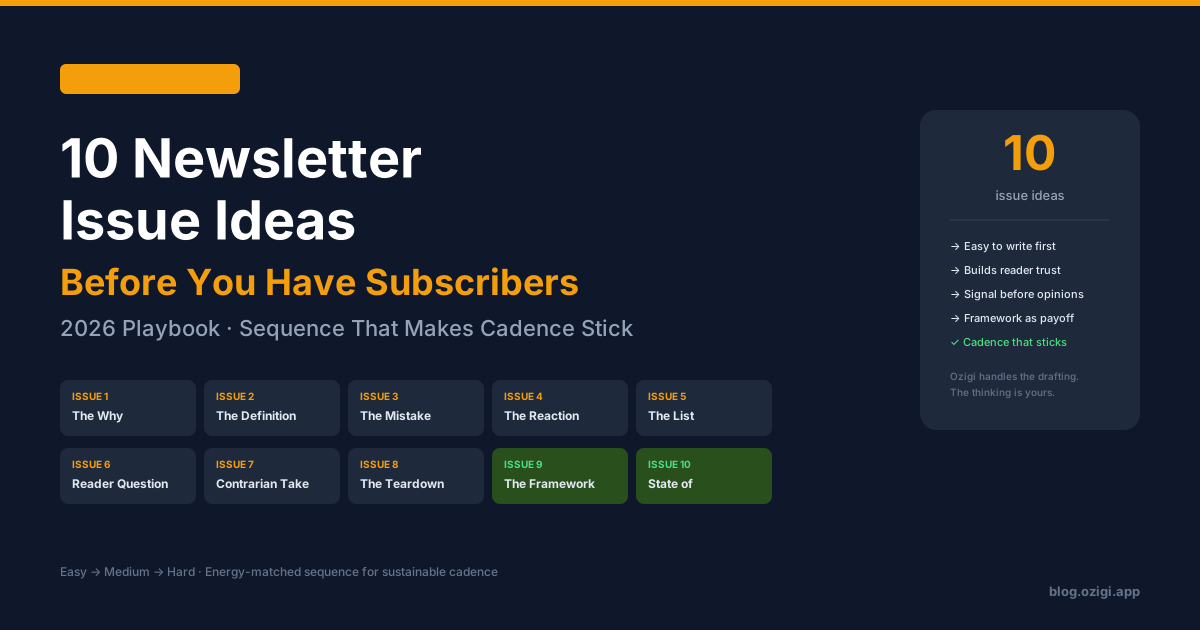
For more on the specific issue types that produce the most repurposable content, see our 10 newsletter issue ideas guide.
A Real Example
Take an issue of a hypothetical newsletter called "Engineering Management Notes." The issue argues that one-on-one meetings should be 45 minutes, not 30, with specific reasoning.
Day 1 LinkedIn post: "Most one-on-ones are 30 minutes. Mine are 45. Here is why the extra 15 minutes changes the conversation entirely." Story-driven, 1,400 characters.
Day 1 X post: "Most one-on-ones are 30 minutes. Mine are 45. The extra 15 minutes is where the real conversation happens. Wrote about it in this week's newsletter: {link}"
Day 2 LinkedIn post: "The first 25 minutes of any one-on-one are about status. The last 20 are about what is actually wrong. Most managers cut the meeting right when the second part starts." 1,200 characters, no newsletter link.
Day 3 X thread: A 7-tweet thread unpacking the specific dynamics of the 25/20 split with examples from the writer's experience.
Day 4 Slack drop: "Question for the group: when do you schedule your one-on-ones, and how long are they? I have been thinking about this and it seems like most teams default to 30 minutes without ever revisiting whether that is the right length."
Day 5 LinkedIn post: A story about a specific one-on-one where the conversation only got real at minute 32. 1,500 characters.
Day 6 X post: "The thing about 30-minute one-on-ones: by the time you get to anything that matters, the meeting is ending."
Day 7 LinkedIn post: "Last week's newsletter was about why one-on-ones should be 45 minutes. This week, why some teams should drop the one-on-one entirely. Coming Wednesday."
Seven posts. One newsletter. 15 minutes of repurposing time after the newsletter was written. The audience that subscribed to the newsletter from any of these posts gets a consistent voice across every touchpoint because the persona is shared.
How to Test This in 30 Minutes
- Open Ozigi. No signup required.
- Drop in the URL of your most recent newsletter issue.
- Generate the multi-platform campaign with LinkedIn, X, Slack, and Discord selected as targets.
- Read the seven posts the system produced.
- Pick the three that feel closest to your voice and ship them this week.
- Track which posts drive newsletter subscribers. Adjust the workflow based on the data.
The Ozigi free tier means the test costs nothing. The unauthenticated path means you can run it without committing to a signup.
FAQ
Can I repurpose a newsletter into social content without an AI tool? Yes, but it takes roughly two hours per week. Most newsletter writers do not have the second two hours after writing the newsletter, which is why repurposing does not happen. The AI tool compresses the time to about 15 minutes, which is the difference between "I will do this" and "I will do this consistently."
Will the repurposed posts sound like AI? Not with Ozigi's persona system and banned lexicon enforcement. The output is shaped by your specific voice profile and the words that mark text as AI-generated are blocked at the API layer. Generic ChatGPT-based repurposing produces output that does sound like AI; Ozigi-based repurposing does not.
Should every newsletter get the full week of repurposing? No. Some issues do not contain enough substance to fan out into seven posts. Others are too narrow. Treat the seven-day map as a maximum, not a minimum. A two-or-three-post repurposing on a thinner newsletter is better than forcing seven generic posts.
What about Instagram and TikTok? Ozigi does not currently publish to those platforms. For Instagram or TikTok repurposing, generate the script or caption in Ozigi and use Buffer's free tier for the actual posting. The persona consistency still applies because the source content is the same.
How long does the repurposing workflow take after the first few times? About 15 minutes per newsletter once you have the workflow down. The first two or three runs take longer (30 to 45 minutes) because you are calibrating the persona and the platform-specific output. By the fifth run, the workflow is mechanical.
Can I schedule the repurposed posts in advance? Yes. LinkedIn and X support direct publishing from Ozigi. Discord and Slack go through webhooks. For platforms Ozigi does not natively cover, scheduling tools like Buffer, Hootsuite, or SocialBee handle the queue.
Is the Ozigi codebase open source? Yes, on GitHub at Ozigi-app/OziGi. The persona system, banned lexicon validator, and multi-platform generation flow are documented on the Ozigi blog.
This article was generated and refined on Ozigi. Start with the free newsletter generator — no signup required.
About the author
Founder and CEO of Ozigi. Writes about content strategy and the architecture of AI tools for technical creators.