How to Start a Newsletter in 2026: A Realistic Guide for People Who Don't Want to Quit by Issue 4

Founder and CEO of Ozigi. Writes about content strategy and the architecture of AI tools for technical creators.
TL;DR
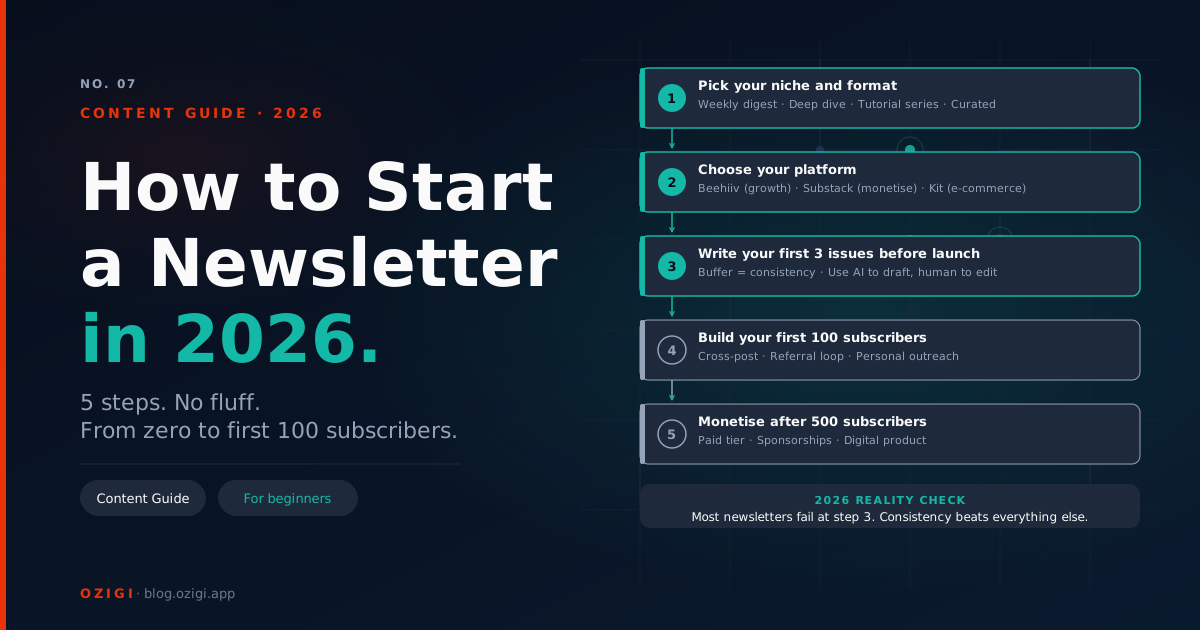
Most newsletter advice optimizes for the wrong thing. It tells you to pick the perfect platform, design the perfect landing page, and craft the perfect launch email. None of that matters if you stop writing by issue four. The actual reason new newsletters die is that the writing cadence becomes unsustainable. This guide is built around that reality. It covers picking a topic narrow enough to keep producing about, building a list before launch, the writing workflow that makes weekly publishing possible, and when to start charging. Ozigi is the writing layer that makes the cadence sustainable, but the strategic advice in this guide applies regardless of which tools you use.
Why Most Newsletters Die at Issue 4
Look at the graveyard of abandoned Substacks, Beehiivs, and Buttondowns. The pattern is consistent. Issue one launches with energy. Issue two takes more effort than expected. Issue three is rushed. Issue four never ships. The writer tells themselves they will restart "next week." They never do.
The cause is rarely the topic, the platform, or the audience. The cause is that the writer underestimated how long a weekly newsletter actually takes. The estimate going in is 90 minutes per issue. The reality, for most people writing in a niche they care about, is three to five hours from concept to published draft.
Most newsletter advice tries to optimize the wrong end of the pipe. It focuses on growth tactics, monetization strategies, and platform selection. None of that matters if the engine producing the content shuts down.
This guide is built around the engine. The platform decision matters but it is downstream. The audience-building tactics matter but they are downstream. The thing that has to work first is the part where you sit down and write the issue every week for six months without burning out.
Step 1: Pick a Topic Narrow Enough That You Cannot Run Out
The most common topic mistake is picking something too broad. "Productivity" is too broad. "Marketing" is too broad. "Personal finance" is too broad. After issue six, you start producing content that is indistinguishable from every other newsletter in the category.
The fix is constraint. Constrain by audience ("productivity for engineering managers at Series B startups"), constrain by format ("one tactical email teardown per week"), constrain by angle ("personal finance for people who hate budgets"). The narrower the topic, the longer you can sustain weekly publishing without repeating yourself.
A useful test: write 20 headlines for the first 20 issues. If you cannot do that in 30 minutes, the topic is too broad or you do not have enough knowledge in it yet. Pick a different topic or do more reading before you launch.
The other useful test: would someone who already gets 30 newsletters this week add yours? Most newsletters fail this test. They are interesting to the writer but not differentiated enough to earn the inbox slot.
Step 2: Build a Small List Before Launch
The "build in public" advice that says "just start, the audience will come" is wrong for newsletters. A newsletter with zero subscribers is psychologically harder to maintain than a newsletter with 50. The 50 subscribers act as social pressure that makes the cadence stick.
Realistic pre-launch list-building tactics for 2026:
- Post about the topic for two to four weeks on the platform where your audience hangs out. For technical founders, that is X and LinkedIn. For marketers, mostly LinkedIn. For creative writers, X and Bluesky. For B2B operators, LinkedIn. Build context for the newsletter before you ask anyone to subscribe.
- Add a soft signup link to your bio and pinned post. Not a hard pitch, just a small "I am starting a newsletter about X" link. The 50 people who would care are looking for permission to give you their email.
- Ask 20 specific people directly. Send 20 personal messages to friends, colleagues, and acquaintances who match the topic. The response rate is high and the early subscribers tend to engage, which builds the data signal your future ESP needs for deliverability.
The target is 50 subscribers before issue one. Most people can get there in two to three weeks of intentional effort.
Step 3: Pick a Platform That Does Not Cost You Yet
The temptation is to sign up for Beehiiv Scale at $49 per month on day one because the marketing makes it look essential. It is not essential. The actual essential features at issue one are:
- A way to collect email addresses
- A way to send to the list
- Basic analytics so you know if anyone opened the email
Every free platform handles these. The 2026 free tier landscape:
- Beehiiv Launch (free, up to 2,500 subscribers): unlimited sends, custom domain, website, basic analytics. AI tools and monetization are gated to the Scale plan at $49 per month.
- EmailOctopus (free, up to 2,500 subscribers): 10,000 emails per month, basic automation. The UI is dated but the limits are generous.
- MailerLite (free, up to 500 subscribers): full automation, landing pages, websites included. The 500-subscriber cap arrives faster than you think.
- Buttondown (free, up to 100 subscribers): Markdown-first, API access, RSS-to-email. Best fit for technical writers.
- Kit (formerly ConvertKit) (free, up to 10,000 subscribers): unlimited broadcasts, no automation on the free tier.
The honest recommendation: pick the platform with the most generous free tier in your target audience size, and migrate later if you need to. List migration is straightforward on every modern ESP via CSV export.
For most new newsletters, Beehiiv Launch or EmailOctopus are the right starting point. Both give you 2,500 subscribers free, which covers most newsletters for the first year.
Step 4: Solve the Writing Cadence Problem
This is the part most guides skip. The platform handles distribution. The audience-building tactics handle growth. Neither helps when you sit down on Tuesday evening with no idea what to write about for Wednesday's send.
Three workflow changes make weekly publishing sustainable.
First, capture material continuously, not just on writing day. Every newsletter writer who lasts builds a swipe file: links saved during the week, transcripts of conversations, half-formed thoughts, screenshots, notes from meetings. By the time you sit down to write the issue, you should already have most of the raw material. The blank-page problem is a capture problem disguised as a writing problem.
Second, decouple drafting from publishing. The professional move is to draft on Sunday for Wednesday, not draft on Wednesday for Wednesday. Sunday-self has time. Wednesday-self has work emergencies. If your cadence depends on Wednesday-self being heroic, the cadence dies.
Third, use AI to compress the draft step, not the thinking step. This is where Ozigi earns its place in a newsletter operation. The thinking, the research, the unique angle, those are yours. The structural draft that turns your scattered notes into a coherent newsletter is the part AI compresses from two hours to 15 minutes. Drop in your raw notes, the link to the source material you are reacting to, and the transcript of the conversation that sparked the idea. Ozigi produces a draft already shaped by your persona. You edit, you add the insight only you can add, you ship.
The honest constraint: AI cannot do the thinking. If you do not have a unique perspective on your topic, no tool produces one for you. AI compresses the time between "I have an idea" and "I have a draft." That is the difference between sustainable weekly publishing and burnout.
Step 5: Why AI Tools Matter More in 2026 Than They Did in 2024
The newsletter AI tools that shipped between 2023 and 2024 mostly produced generic prose. LinkedIn's 360Brew algorithm and Google's AI Overviews have since changed the cost of generic AI-generated content from "low engagement" to "no distribution." Median organic reach on LinkedIn fell roughly 47% between mid-2024 and mid-2025 according to AuthoredUp's reach study of three million posts.
For newsletters, the parallel pressure is the unsubscribe button. Readers got noticeably better at recognizing AI-generated content in 2025. Newsletter open rates declined and unsubscribe rates rose for any publication that leaned heavily on generic AI drafting.
The AI tools that work for newsletter writing in 2026 are the ones that produce output that does not pattern-match to AI. The mechanism matters. Beehiiv's AI Writing Assistant is a GPT wrapper inside the editor. Substack does not have a meaningful AI feature. Kit's AI is limited to subject-line suggestions.
Ozigi takes the opposite approach. The banned lexicon enforced at the API level blocks tokens that mark text as AI-generated. The persona system enforces a specific writer voice across every generation. The validator architecture is open-sourced and runs production telemetry to catch new AI vocabulary as it emerges.
This matters for newsletter writers specifically because the inbox is the highest-stakes surface for AI detection. Social posts get scrolled past. Newsletter emails get opened, read for 20 to 60 seconds, and judged. If the writing reads as AI-generated, the unsubscribe rate climbs. The persona-driven approach makes the AI invisible.
Step 6: When to Start Charging
The standard advice is "monetize from day one." For most newsletters, this is wrong. Charging from issue one creates two problems. First, you spend the first six months optimizing for paid conversion instead of writing. Second, your subscriber acquisition rate drops because asking for $7 per month from a stranger is harder than asking for an email.
The honest path:
- Issues 1 to 12: free. Focus on cadence, voice, and growth. Get to 500 subscribers.
- Issues 13 to 24: still free. Identify which content drives the most opens and replies. Build the case for paid.
- Issue 25 onward: introduce paid tier. Offer a paid version that adds something genuinely valuable (deeper analysis, exclusive interviews, premium archives) without removing value from the free version.
The platforms that handle paid subscriptions in 2026:
- Beehiiv Scale ($49/month): 0% platform fee on paid subscriptions, only Stripe's 2.9% + $0.30 applies
- Substack: 10% platform fee plus Stripe's 2.9% + $0.30
- Ghost: open-source, self-host for cost of hosting, or Ghost Pro at $11/month
- Kit Creator ($29/month): built-in paid subscriptions, no platform fee
For most newsletters that reach the monetization stage, Beehiiv Scale is the right answer because the 0% platform fee compounds significantly compared to Substack's 10% cut over time.
Step 7: The Honest Tool Stack for a New Newsletter in 2026
For someone starting today with no money to spend:
- Writing: Ozigi's free newsletter generator (no credit card)
- Sending: Beehiiv Launch or EmailOctopus (both free, both 2,500 subscriber cap)
- Grammar: LanguageTool free tier (20,000 characters per check)
- Readability: Hemingway Editor (free web version, no signup)
- Topic capture: Notion free tier or Obsidian (free)
- Social promotion: Buffer free tier for scheduling, Ozigi for the content itself
Total monthly cost: $0. Total time to set up: under one afternoon.
The realistic upgrade path:
- At 500 subscribers: stay free, evaluate Substack discovery, evaluate Beehiiv Boosts (requires Scale)
- At 1,000 subscribers: consider Beehiiv Scale ($49) for AI tools, monetization, and Boosts
- At 2,500 subscribers: required to upgrade beyond the free tier; Beehiiv Scale or EmailOctopus paid plan
- At 5,000 subscribers: consider deliverability investments (custom domain, dedicated IPs at higher tiers)
What Most New Newsletter Operators Get Wrong
Three patterns from watching dozens of new newsletters launch and fail.
They overinvest in launch and underinvest in cadence. The launch email gets six revisions. Issue four gets no time at all because the writer is tired. Reverse the priority. Launch is one issue out of 100. Cadence is the actual product.
They pick a topic too broad. "Marketing" newsletters compete with thousands. "Marketing for B2B SaaS founders who do not have a CMO yet" competes with maybe a dozen. The narrow topic creates the distinction that earns the subscribe.
They confuse list size with engagement. A 200-subscriber list with 60% open rates and consistent replies is more valuable than a 2,000-subscriber list with 12% open rates. The first list buys things, refers friends, and gives you signal. The second list is dead weight.
How to Use Ozigi Specifically for a New Newsletter
The workflow that compresses weekly newsletter time without sacrificing voice:
- Set up your persona at ozigi.app/dashboard/personas/marketplace so every generation is shaped by your specific voice from day one
- Capture raw material continuously: save links, paste meeting notes, record voice memos, drop screenshots into a single folder
- On drafting day: drop the raw material into Ozigi. Drop links. Paste notes. Upload PDFs.
- Generate the newsletter draft using your persona
- Edit for the insight only you can add: the specific story, the personal angle, the data point from your own work
- Run through LanguageTool and Hemingway for grammar and readability
- Send via Beehiiv Launch or EmailOctopus (or directly via Ozigi for smaller lists)
Total time from raw material to sent newsletter: 90 minutes if you have done it five times. The first three issues take longer because you are calibrating your persona and the workflow. By issue five, the cadence becomes sustainable.
FAQ
How long does a newsletter actually take to write each week? For an honest weekly newsletter in a niche topic, three to five hours from idea to sent. Faster if you have done it dozens of times and have a strong workflow. Longer if you are still calibrating voice and topic.
What is the best free newsletter platform for 2026 beginners? Beehiiv Launch or EmailOctopus, both at 2,500 subscribers free. Beehiiv has better publisher features and an established ecosystem. EmailOctopus has a simpler setup. Either works.
Can Ozigi replace writing a newsletter myself? No, and that is the point. Ozigi compresses the drafting step so the thinking step gets more time. The unique angle, the insight, the personal voice still come from you. Ozigi prevents the generic AI-drafted output that destroys newsletter open rates in 2026.
Should I start with a paid newsletter from day one? No. The standard "monetize from day one" advice fails for most new newsletters. The honest path is free for the first 12 to 24 issues, then introduce paid as a tier that adds genuine value rather than as a gate on the existing content.
How many subscribers do I need before launching? A pre-launch list of 50 subscribers makes the cadence sustainable. Below that, the silence after each send tends to demotivate writers and the cadence breaks.
How often should a newsletter publish? Weekly is the standard. Biweekly works for newsletters with deeper analysis. Monthly is too slow for audience-building because readers forget you between sends. Daily is unsustainable for most solo writers.
What is the realistic time to 1,000 subscribers? For a niche newsletter with consistent publishing and active social promotion, six to nine months. Some hit it faster. The honest range for solo creators without an existing audience is six to 18 months.
Is the Ozigi codebase open source? Yes, on GitHub at Ozigi-app/OziGi. The banned lexicon validator, persona system, and email delivery layer are documented on the Ozigi blog.
This article was generated and refined on Ozigi. Try the free newsletter generator yourself — no signup required.
About the author
Founder and CEO of Ozigi. Writes about content strategy and the architecture of AI tools for technical creators.