What Does Go-to-Market Look Like for a Solo Founder or a Small Technical Team?

Founder and CEO of Ozigi. Writes about go-to-market, content strategy, and the tooling small teams rely on.
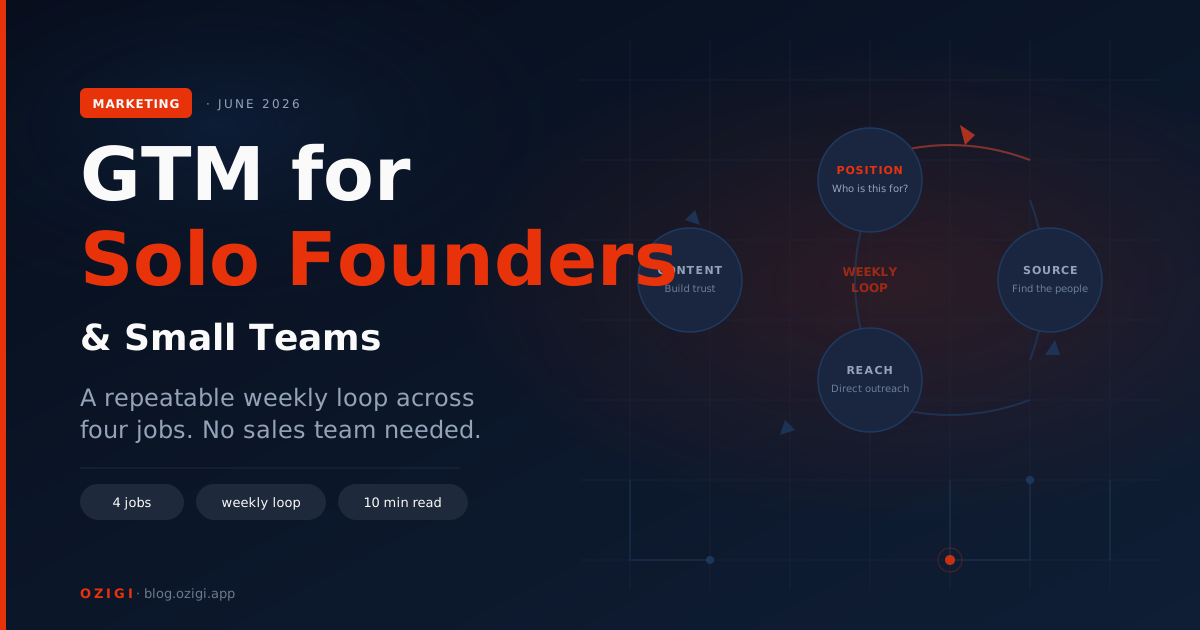
TL;DR: Go-to-market is not a sales team you cannot afford yet. For a solo founder or a small technical team it is a repeatable weekly loop across four jobs: deciding who you are for, finding those people, reaching them, and giving them a reason to care. The common failure is building for months and distributing never. You win by running a narrow, honest loop with one voice across outreach and content, not by buying a bigger stack. This guide breaks down each job, the mistakes that stall small teams, and the lean toolset that runs the whole motion.
The hardest part of building a product is not building it. It is getting the right people to find it, try it, and stay.
Most technical founders get this backward. We are comfortable in the codebase and uncomfortable in the inbox, so we ship features and hope distribution sorts itself out. It does not. CB Insights' 2026 analysis of failed startups found poor product-market fit behind 43% of shutdowns, while running out of cash, the most cited cause at 70%, is usually the symptom of nobody adopting the thing, not the root problem (CB Insights research).
Go-to-market is the work that closes that gap. This is what it actually looks like when your team is one person, or five, and your budget is closer to zero than to a sales org.
What Is Go-to-Market, in Plain Terms?
Go-to-market is the repeatable system you use to turn a product into customers. It answers four questions: who is this for, where do they already spend attention, how do you reach them, and why should they care this week.
That is the whole thing. Strip away the jargon and a go-to-market motion is just a loop you run on a schedule. You pick a narrow audience, you put your product in front of them where they already are, you give them a reason to pay attention, and you follow up with the ones who lean in.
A large company runs this loop with separate teams for demand, sales, and content. A small team runs the same loop with one or two people and a tight set of tools. The shape is identical. The scale is not.
Why Do Technical Founders Struggle With Go-to-Market?
Technical founders struggle because the skills that build a great product are the opposite of the skills that distribute it. Building rewards depth, patience, and working alone. Distribution rewards repetition, visibility, and talking to strangers before the product feels ready.
There are three traps that show up again and again.
The first is the build-and-pray trap: spending six months perfecting features no user has asked for, then launching to silence. The second is the one-shot launch trap: treating Product Hunt or a single Show HN post as the whole strategy, then having no plan for the Tuesday after. The third is the voice trap: outsourcing the writing to a tool that makes everything sound like a marketing department, which technical audiences spot and distrust instantly.
The fix for all three is the same. Treat distribution as a habit, not an event, and keep it in your own voice.
What Are the Parts of a Go-to-Market Motion for a Small Team?
A small-team motion has four jobs: positioning, sourcing, outreach, and content. You do not need a department for each. You need a clear answer for each and a weekly rhythm that touches all four.
- Positioning. Decide who you are for and what you replace. This is your ideal customer profile and your one-sentence pitch.
- Sourcing. Build a list of real people who match that profile, with enough context to write to them like humans.
- Outreach. Reach those people directly, on email or LinkedIn, with a short, specific message and a follow-up or two.
- Content. Publish things your audience finds useful, so that when your outreach lands, your name is already familiar.
The order matters. Positioning feeds sourcing. Sourcing feeds outreach. Content runs alongside all of it and makes the outreach work harder. Skip positioning and every later step gets vaguer and weaker.
How Do You Choose Your Ideal Customer Profile First?
You choose an ICP by getting narrow on purpose. Pick the smallest group of people who feel your problem most sharply, then describe them in terms you can actually search for: their role, their tools, the keywords in their bio, the size of company they work at.
"Developers" is not an ICP. "Backend engineers at seed-stage startups who maintain a public API and complain about Postman pricing" is an ICP. The second one tells you where to find them, what to say, and what to write about.
Narrow feels risky because it shrinks your market on paper. In practice it does the opposite. A specific message to 200 well-chosen people beats a generic message to 2,000 strangers every time, because the specific message sounds like it was written for one person. You can widen later. You cannot get traction wide.
If your buyers are technical, the good news is they leave public trails: GitHub profiles, Dev.to posts, conference talks, open issues. That makes a developer-first ICP one of the easiest to source against, which is the next job.
How Do You Reach the Right People Without a Sales Team?
You reach them with direct outreach that reads like a person wrote it, sent in small daily batches, with a short sequence of follow-ups. No call center, no quota board, just a tight list and a real message.
The mechanics are simpler than they sound. You source a list that matches your ICP. You write a short first email or LinkedIn note that references something true about the person, not a generic compliment. You send a modest number per day to protect your sending reputation. You follow up once or twice, then you stop and move on. Replies pause the sequence so a real conversation can take over.
Two things separate outreach that works from outreach that gets deleted. The first is specificity: the message has to show you know who you are writing to. The second is restraint: short, honest, and easy to say no to. The founders who win at cold outreach are not the ones who send the most. They are the ones whose messages do not feel like spam.
For the full breakdown of how the tools in this category price and compare, our guide to the best free GTM tool in 2026 walks through Apollo, Clay, lemlist, and the all-in-one option side by side.
Why Does Content Belong in Your Go-to-Market Motion?
Content belongs in your motion because it warms the people your outreach is about to reach. A cold email to someone who has already read a useful post from you is not really cold. It converts because the trust was built before the ask.
Content does three jobs at once for a small team. It makes your outreach land warmer, because the recipient recognizes your name. It compounds over time, because a good post keeps pulling in readers and, increasingly, gets cited by AI search, which we covered in our guide to GEO and AEO. And it gives you something to say in the follow-up that is not just "did you see my last email."
This is the part most "growth hacks" miss. Outreach without content is a stranger knocking on a door. Content without outreach is a shop with no one walking past. Run together, they make each other work.
How Do You Run Outreach and Content With One Voice?
You run them with one voice by defining that voice once and applying it everywhere, instead of letting each tool impose its own default tone. The cold email and the blog post should read like the same person, because to your reader, they are.
This is where most stacks break. The writing tool was tuned for marketing copy, the sending tool has its own templates, and the two never share anything. The result is a blog post in one voice and a cold email in another, and an audience that notices the seam.
The cleaner approach is a single voice profile, applied to both. At Ozigi we call this a System Persona: a saved definition of who is writing, how they sound, and what they would never say. We pair it with a Banned Lexicon that strips the generic AI vocabulary out of every output, blog post and cold email alike, and a human-in-the-loop edit step so the final word is always yours. One voice, two channels, no seam.
What Does a Weekly Go-to-Market Loop Look Like for a Team of One to Five?
A working loop fits in a few hours a week. The point is consistency, not volume. Here is a version you can run starting Monday.
- Refresh the list (30 minutes). Source 20 to 50 new people who match your ICP. Score them so you only write to the strong matches.
- Publish one piece of content (60 to 90 minutes). A short post, a teardown, a lesson from your week. Useful, specific, in your voice.
- Send a small outreach batch (30 minutes). Write to the day's qualified leads with a message that references something real. Keep daily volume modest.
- Follow up and reply (20 minutes a day). Let the sequence handle step two and three. Jump in the moment someone responds.
- Review on Friday (20 minutes). What got replies, what got read, what to write about next week.
Five steps, run weekly, beats a heroic launch month followed by silence. The compounding is the whole game.
What Tools Do You Actually Need to Run GTM as a Small Team?
You need four things: a way to source and score leads, a way to send sequences, a way to produce content, and one voice tying them together. You can buy these as separate tools, or run them as one suite.
The separate-tools route works but adds up fast: a data tool, a sender, and a writing tool is three subscriptions, three logins, and the voice seam described above. For many small teams that is $150 or more a month before anyone replies.
The suite route is why we built the Ozigi GTM engine. It sources leads from GitHub, Dev.to, and LinkedIn, scores each one against your ICP, runs email and LinkedIn sequences in your persona voice, syncs to your CRM, and writes your content with the same engine. The free tier runs the full loop with no credit card, and you can watch it work on the live demo. The point is not the brand. The point is that one voice across all four jobs is the thing that makes a small-team motion feel like a real company rather than a stranger in the inbox.
Whichever route you pick, the loop is what matters. Tools make it faster. They do not replace the habit.
Frequently Asked Questions
What is a go-to-market motion? A go-to-market motion is the repeatable system a team uses to turn a product into customers. It covers four jobs: deciding who the product is for, finding those people, reaching them directly, and publishing content that gives them a reason to care. Small teams run the same loop as large ones, at smaller scale.
Do I need a sales team to do go-to-market? No. A solo founder can run a complete go-to-market motion with direct outreach, a content habit, and a few hours a week. Founder-led outreach often outperforms a junior sales hire early on, because founders know the product and the problem better than anyone they could hire to pitch it.
What comes first, content or outreach? Positioning comes first, then both run together. Decide your ideal customer profile, then publish content and send outreach in parallel. Content warms the people your outreach reaches, and outreach gives your content a direct audience. Running one without the other leaves most of the value on the table.
How narrow should my ideal customer profile be? Narrower than feels comfortable. Pick the smallest group that feels your problem most sharply and describe them in searchable terms: role, tools, bio keywords, company size. A specific message to 200 well-chosen people beats a generic message to thousands, because it reads like it was written for one person.
How much time does a small-team GTM loop take per week? A few hours. A workable weekly loop is roughly 30 minutes sourcing leads, 60 to 90 minutes publishing one piece of content, 30 minutes sending a small outreach batch, 20 minutes a day on replies, and a short Friday review. Consistency matters far more than volume.
Why does AI-written outreach often fail? Because most AI tools default to generic marketing vocabulary that technical readers recognize and distrust. The fix is a defined voice plus a hard constraint against filler words, applied to both content and outreach, with a human edit step so the message stays specific and honest rather than smooth and empty.
Building a go-to-market motion as a small team? Ozigi runs the full loop, sourcing, scoring, outreach, and content, in one voice and on a free tier. Questions or want to compare notes? Reach out at hello@ozigi.app. Try the free cold email generator or the free LinkedIn outreach generator first — no signup required.
About the author
Founder and CEO of Ozigi. Writes about go-to-market, content strategy, and the tooling small teams rely on.