How to Make Your LinkedIn Content Stand Out in 2026 (Under the 360Brew Algorithm)

Founder and CEO of Ozigi. Writes about content strategy and the architecture of AI tools for technical creators.
TL;DR: LinkedIn replaced its algorithm in late 2025 with a 150-billion-parameter AI model called 360Brew. Organic reach fell roughly 50% year-over-year and most creators haven't adjusted. What works now: expertise-aligned profiles, topic consistency, writing that reads as genuinely human, and earning saves and thoughtful comments instead of likes. This guide covers what changed, what the data shows, and how to rebuild a content strategy that LinkedIn's new algorithm actually rewards.
How to Make Your LinkedIn Content Stand Out in 2026 (Under the 360Brew Algorithm)
If your LinkedIn posts are getting less reach than they were a year ago, it's not your imagination and it's definitely not a passing glitch. Something fundamental changed at the platform level on LinkedIn in the back half of 2025, and most creators are still playing by rules that no longer apply.
AuthoredUp’s LinkedIn reach study of over three million LinkedIn posts found that 98% of users experienced a decline in reach, with median impressions falling 47% between mid-2024 and mid-2025. For accounts with 50,000 or more followers, the drop was steeper: 62% less reach, 67% less engagement, 83% slower follower growth.
This article is for anyone who writes on LinkedIn and wants to understand what actually drives visibility now. It covers what 360Brew is and how it works, what the best-performing creators are doing differently, how to write content that the algorithm reads as human rather than AI-generated, and the specific tools and tactics you can apply this week to recover.
What Is 360Brew and Why Did LinkedIn Replace Its Algorithm?
360Brew is a 150-billion-parameter AI foundation model built by LinkedIn's Foundation AI Technologies team. It replaced the previous ranking system ( a collection of thousands of separate, task-specific machine learning models) with a single unified AI that evaluates everything together. LinkedIn publicly confirmed the architecture in March 2026 through its engineering blog, backed by two arXiv research papers:
- 360Brew: A Decoder-only Foundation Model for Personalized Ranking and Recommendation
- Large Scale Retrieval for the LinkedIn Feed using Causal Language Models.
The easiest way to understand the difference is to think of it this way: the old algorithm was a factory assembly line, checking individual boxes like likes, comments, and hashtags. 360Brew, on the other hand, reads your post the way a human editor would. It understands what you're saying, evaluates whether you appear credible enough to be saying it, and decides whether the people who engaged with it actually cared.
The technical architecture, documented by Trust Insights’ analysis of LinkedIn AI systems, is a two-stage pipeline: a Causal LLM built on LLaMA-3 acts as a retrieval gate that decides whether your content even enters competition, followed by a Generative Recommender that decides where it ranks. Your profile directly determines whether your post passes the first gate. Your content determines where it ranks in the second. This is the reason keyword stuffing your content doesn't work anymore. And why hashtag strategies stopped mattering. Also why posting frequently without a clear topic focus actively hurts your reach. The system is reading your content semantically and checking whether it aligns with an established expertise signal, not counting engagement signals in isolation.
Why Your LinkedIn Reach Dropped in 2026
There are three mechanical reasons reach declined, and understanding each one changes how you respond.
First, more people are posting. Active weekly posters grew from 0.9% to 1.1% of all LinkedIn users. The pie got bigger, and unfortunately, your slice got smaller. Second, ad inventory expanded. LinkedIn is eating more feed real estate with sponsored content and promoted posts to support its growth into a $5B+ quarterly revenue business.
Third, and most importantly, 360Brew's quality filter is strict. The system is actively deprioritising content it classifies as “low-effort”, “AI-generated”, or poorly aligned with the author's stated expertise. Generic, template-style posts that worked in 2023 now stall at a few hundred impressions when they used to pull thousands.
The last factor is where most of the pain is concentrated. An Originality.ai AI content detection study, analysing nearly 9,000 LinkedIn long-form posts found that likely AI-generated posts received 45% less engagement than likely human-authored ones. When over half of long posts on LinkedIn are now produced with AI assistance, the distinction between "AI-assisted and reviewed" and "AI-dumped and published" is becoming a clear ranking signal.
What 360Brew Actually Rewards
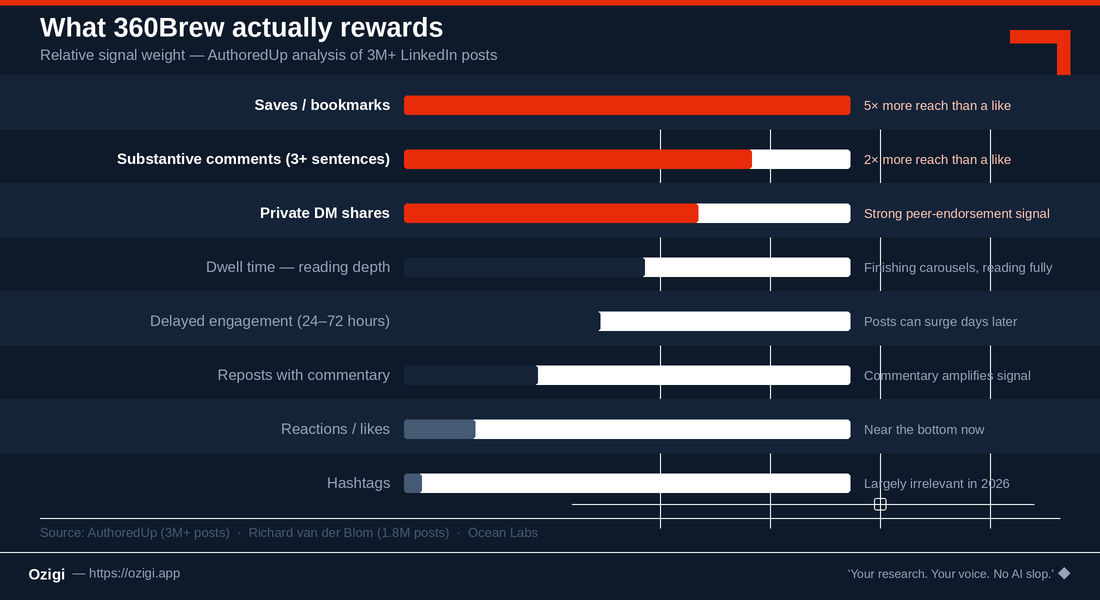
The data is unusually consistent across sources. Richard van der Blom's analysis of 1.8 million posts, AuthoredUp's three million, and Ocean Labs' research all point to the same ranking hierarchy. The strongest signals, in order of weight: Saves. When someone bookmarks your post, 360Brew interprets it as a strong signal that your content has lasting value. AuthoredUp's data shows saves drive 5x more reach than a like and 2x more than a comment. LinkedIn added Saves and Sends to post analytics in late 2025 specifically because they matter more now.
Substantive comments. Comments of three or more sentences carry dramatically more weight than reactions. Top 1% creators leave 286 replies per week versus 34 for average creators. That's 741% more commenting activity. There's a strong statistical correlation between commenting frequency and follower growth.
Private shares via DM. When someone sends your post to a colleague, 360Brew treats that as a near-endorsement. Private sharing often carries more algorithmic weight than visible reactions.
Dwell time. How long readers actually spend on your post. Clicking "see more" matters. Finishing a carousel matters. Watching a video to the end matters. Quick scroll-by likes barely register.
Delayed engagement. This is counterintuitive but important. Posts that receive saves and thoughtful comments 24-72 hours after publishing perform 4-6x better than posts that spike early and die. 360Brew reads sustained attention as a sign of lasting value. One of Botdog's founders documented a post that received average engagement in the first 48 hours, then accumulated nearly 100,000 views once saves started piling up around hour 72.
Likes are near the bottom of the hierarchy. Hashtags are essentially irrelevant. The algorithm reads your actual words and understands semantic context directly. Engagement pods are actively detected and penalised, with LinkedIn's VP of Product Gyanda Sachdeva stating publicly that the goal is to make them "entirely ineffective."
The Profile-Content Match: The First Gate
Before 360Brew even considers who should see your post, it performs what researchers call a "profile-content audition." It cross-references your post against your headline, About section, work experience, and activity history.
If your profile says you're a Marketing Director but you're posting about cryptocurrency, the algorithm reads that as a mismatch and suppresses distribution. If your profile describes you as a frontend engineer and you post about React architecture decisions, the system assigns high confidence and unlocks broader reach. This means your profile is now part of your content strategy, not separate from it. LinkedIn needs approximately 90 days of consistent posting within a defined niche before it reliably categorises your expertise. Professionals who post on scattered topics, e.g leadership Monday, UX Tuesday, workplace wellness Wednesday, are treated as generalists and receive general distribution, which means low distribution.
The fix is content pillars. Pick two or three core topics that map directly to what your profile claims you know about. Post consistently within those pillars. Let 360Brew categorise you as someone with demonstrable expertise in specific areas rather than a generalist with a polished profile.
How to Write Content That Reads as Human (Not AI)
This is where most creators are losing ground in 2026 and most aren't even aware of why.
LinkedIn's system is now sophisticated enough to identify content patterns characteristic of AI-generated text. It's looking for structural tells (uniform sentence rhythm, predictable transitions, overuse of certain vocabulary) not just flagging posts that happen to use AI tools. The distinction matters because AI tools aren't the problem. Unreviewed, unedited, generic AI output is.
Here's what 360Brew's AI detection flags, based on the patterns consistently appearing across industry research:
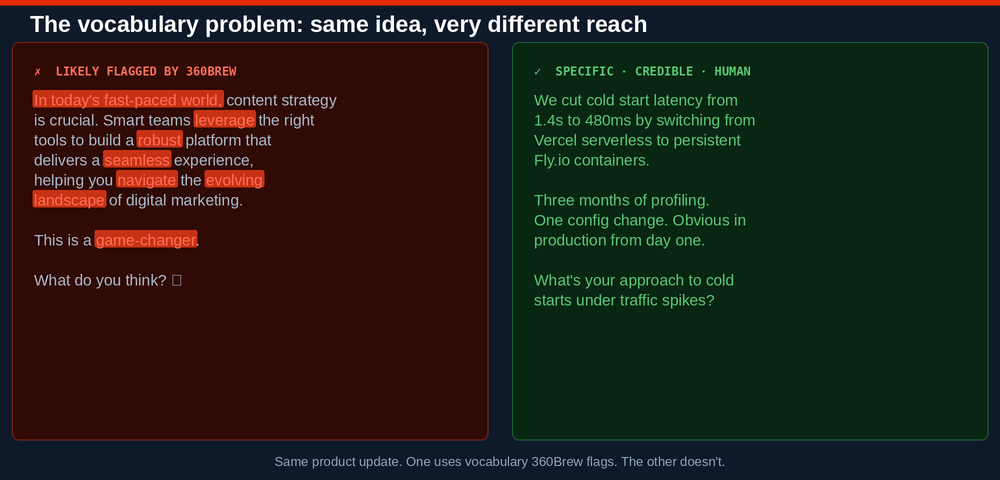
Vocabulary patterns. Words like delve, tapestry, leverage, robust, seamless, revolutionise, holistic, transformative, game-changer, paradigm, multifaceted, navigate, impactful. These appear in training data at disproportionate rates and form the fingerprint of generic AI output. Their presence alone won't trigger suppression, but their density across multiple posts builds a classification signal.
Uniform sentence length. Humans write in mixed rhythms: short (punchy) sentences followed by longer explanatory ones, fragments for emphasis, occasional asides. AI tends toward medium-length sentences repeated consistently. Reading your post aloud is the fastest diagnostic. If every sentence takes roughly the same amount of time to say, you've got a problem.
Generic openers and closers. "In today's fast-paced world." "It's not about X, it's about Y." "What do you think?" "Drop your thoughts in the comments." These are flagged as engagement bait patterns. Even when they come from a human writer, they read to 360Brew as the tells of either AI content or low-effort human content.
Lack of specificity. Claims without numbers, tools, or named examples read as generic. "We improved performance significantly" is AI-coded. "We cut cold start latency from 1.4s to 480ms by moving to persistent containers" is human-coded. The more specific your content, the further it travels.
The fix isn't to stop using AI tools. That ship has sailed. A good 28% of active LinkedIn posters use AI assistance according to recent statistics. The fix is to use AI tools that produce content which doesn't read as AI. That means either significant manual editing of raw AI output, or tools that enforce these constraints at the generation layer so you start with output that doesn't need to be fixed.
This is the architectural decision behind the Banned Lexicon in Ozigi: a list of words and phrases the engine is forbidden from producing at the API level. The idea is that the tokens 360Brew uses to classify AI content should never appear in the output in the first place, rather than being caught and rewritten afterward. Other tools like AuthoredUp focus on post-publication editing and formatting. Both approaches solve different halves of the problem. The key principle either way: the specific, textured voice has to survive the tool you use to produce the content.
The LinkedIn Post Format That's Working in 2026
Format matters more than it used to because 360Brew uses format as a dwell-time signal. Based on Q1 2026 engagement data, the hierarchy is clear:
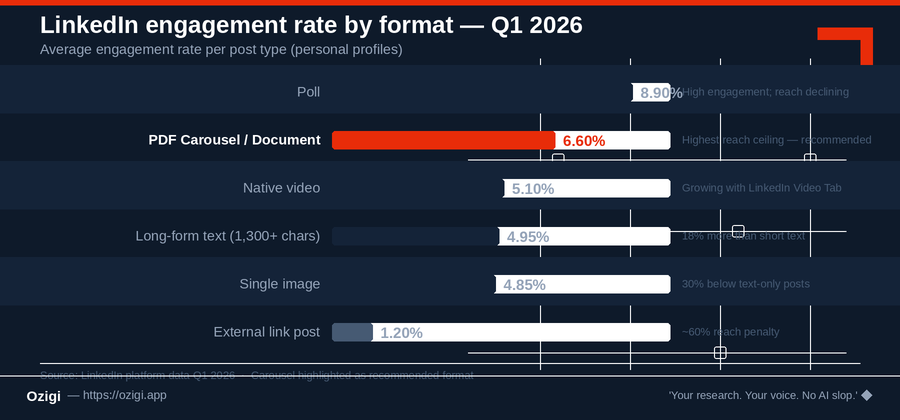
Carousel / document posts: 6.60% average engagement rate. This is the highest-performing format on LinkedIn right now. Each slide swipe counts as engagement and increases dwell time. Keep carousels to 8-10 slides to avoid low-completion penalties.
Polls: 8.9% engagement rate for personal profiles, though reach is down 28% as the format gets overused.
Native video: 5.1% engagement for native uploads. Up from previous years as LinkedIn pushes video heavily through its dedicated Video tab.
Long-form text: Posts over 1,300 characters get 18% more engagement than short posts. Reversal of the trend from 2022-2023.
Single-image posts: 4.85% engagement, now underperforming text-only posts by 30%. Single images trigger a dwell-time penalty because they don't require the reader to stay on the post.
If you want the highest probability of strong distribution, turn your best text posts into PDF carousels. Each one takes more effort to produce but the engagement ceiling is meaningfully higher.
How To Create Better LinkedIn Posts
This is the short version of the article for people who just want to know what to change starting today.
-
Tighten your profile-content match. Audit your headline, About section, and last 30 posts. If they don't all reinforce the same two or three topics, fix your profile first. Content performance is capped by profile credibility.
-
Stop writing generic closers. Kill "What do you think?" and "Thoughts?" and all their variants. Replace with specific, practitioner-level questions that someone with domain knowledge would want to answer. "What's your current approach to X when Y constraint applies?" is a question that attracts thoughtful comments. Thoughtful comments carry the most algorithmic weight.
-
Engage for 60 minutes after posting. Reply to every comment. Respond to reactions. Stay in the thread. 360Brew watches whether the author engages after publishing. "Post and ghost" behaviour gets explicitly deprioritised.
-
Convert your strongest posts into carousels. Pick one post per week that resonated and rebuild it as an 8-10 slide PDF carousel. The format multiplier is the largest single lever available.
-
Move links to the first comment. In-post external links reduce reach by approximately 60%. First-comment links still carry a small penalty but it's significantly lower. Better yet, write content that stands on its own without requiring the reader to leave LinkedIn.
-
Audit your content for AI tells. Read your last five posts aloud. If the rhythm is uniform or you spot vocabulary like "delve", "leverage", or "robust" appearing regularly, rewrite them. Use tools that produce output without those patterns, or edit aggressively after generating.
Tools That Help With LinkedIn Content
No single tool will rescue your reach. What helps is pairing the right tools for the right jobs.
For post editing and formatting, AuthoredUp is the standard. It installs as a Chrome extension and adds a formatting editor directly to LinkedIn's composer, with drafts, analytics, and post previews.
For analytics, (https://shieldapp.ai/) gives you post-level data that LinkedIn's native analytics don't surface — dwell time patterns, engagement quality, what's actually performing and why.
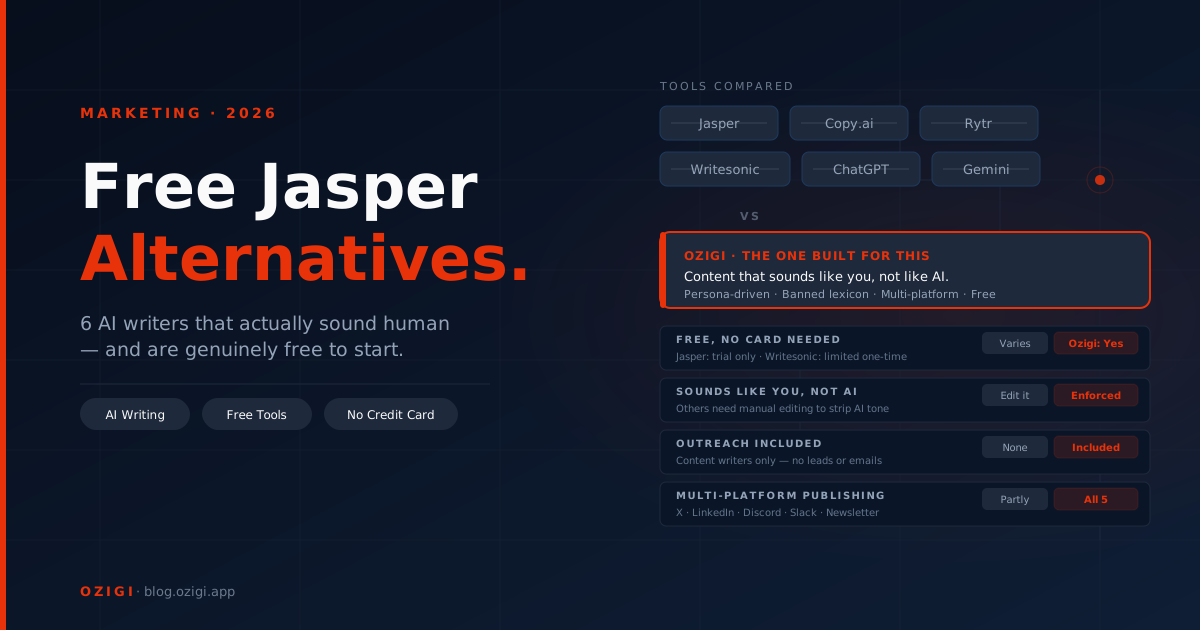
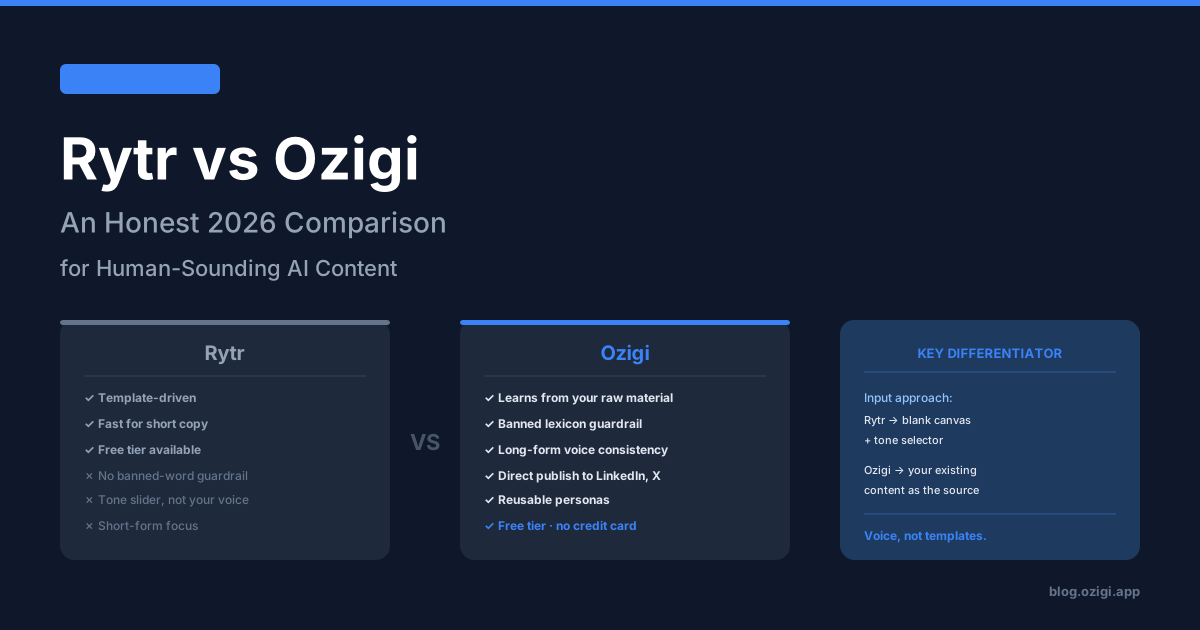
For content generation, the makret is crowded. Most general AI writing tools produce output that 360Brew flags. If you're using one and your reach has dropped, that's a meaningful data point. Tools specifically designed with algorithm awareness, Ozigi, for instance, enforces the Banned Lexicon at the generation layer. They tend to produce content that requires less rewriting before publishing. 360Brew doesn’t just test whether a tool is AI or not. It checks whether the output of that tool reads as AI after you've applied it.
For the other half of LinkedIn growth, actually reaching new people rather than just posting, Ozigi's free LinkedIn outreach generator writes connection notes and follow-up messages under the same banned-lexicon constraint, so your outbound messages don't tank your profile-content match either.
For scheduling, Buffer and Hootsuite are safe. LinkedIn officially supports third-party scheduling via its API. Avoid engagement automation tools; those are actively flagged. The honest truth is that tool selection matters less than editorial judgement. The best creators are using AI tools at every stage of their workflow. They're just reviewing, editing, and owning the final output.
Frequently Asked Questions
Does LinkedIn penalise all AI-generated content?
No. LinkedIn has publicly stated it doesn't penalise AI-assisted content specifically. It penalises low-quality, generic, or spammy content regardless of who or what produced it. The distinction is whether your final output reads as authentic, expert-level content or as template-style filler. AI tools are fine. Unedited AI output is not.
How long does it take to recover reach after an algorithm hit?
The research suggests 60-90 days of consistent posting within clearly defined content pillars before 360Brew reliably recategorises your expertise and expands distribution. There's no quick fix. The reset is real and the recovery is gradual.
Are hashtags still worth using on LinkedIn?
Largely not. 360Brew reads semantic context directly from your content. Using more than two or three hashtags can trigger spam detection. If you use them, keep them minimal and directly relevant to your topic pillars.
Should I delete posts that get low engagement in the first hour?
No. Delayed engagement is rewarded more than it used to be. Posts can accumulate views and saves 24-72 hours after publication and perform 4-6x better than they looked at hour one. Give posts time before concluding they failed.
What's the best time to post on LinkedIn?
Tuesday through Thursday between 8-10 AM and 12-1 PM in your audience's time zone is the consistently-reported optimal window. But timing matters less than content quality under 360Brew. A strong post at a suboptimal time will outperform a weak post at the perfect time.
Do LinkedIn carousels actually get more reach?
Yes. 6.60% average engagement rate makes document posts the highest-performing format on LinkedIn currently. Each slide swipe counts as engagement and dwell time is extended. The format requires more production effort but the ceiling is higher.
Are engagement pods worth trying?
No. LinkedIn actively detects coordinated engagement patterns using comment velocity, account relationships, and timing signatures. Pods get flagged and participating accounts face reach suppression or temporary shadow bans. The short-term boost is not worth the long-term penalty.
How do I know if my content is being flagged as AI-generated?
There's no official indicator but consistent signals: drops in reach that don't correlate with other changes, content that sat well in your analytics tool but underperformed once published, and posts that follow your usual format but stall where similar posts previously travelled. If you're using AI tools in your workflow and noticing these patterns, the output may need more aggressive editing or a different tool.
Closing Thoughts
The answer isn’t to boycott LinkedIn. It is better to understand what is required of you. 360Brew is more aligned with what LinkedIn has always claimed to want: substantive professional content from people with genuine expertise, and less tolerant of the growth-hacking tactics that dominated the previous era.
For creators who actually have expertise and something worth saying, this is good news. The bar for entry is higher but the playing field is fairer. You don't need 100,000 followers to outperform a big account anymore. You need a clear profile, consistent topics, content that reads as authentically yours, and the patience to let posts mature.
The creators winning in 2026 aren't posting more. They're posting more deliberately, engaging more thoughtfully, and treating LinkedIn as a place to build credibility over time rather than chase virality. The tools and tactics will keep evolving. The underlying principle won't: the platform rewards what it reads as real.
Have a specific LinkedIn reach problem you're trying to solve? I built Ozigi specifically to address the AI-content problem under 360Brew. The engine ships with a constraint system that blocks the vocabulary patterns the algorithm flags. Free to try, no credit card required. Also try the free LinkedIn outreach generator for connection requests and DMs.
About the author
Founder and CEO of Ozigi. Writes about content strategy and the architecture of AI tools for technical creators.