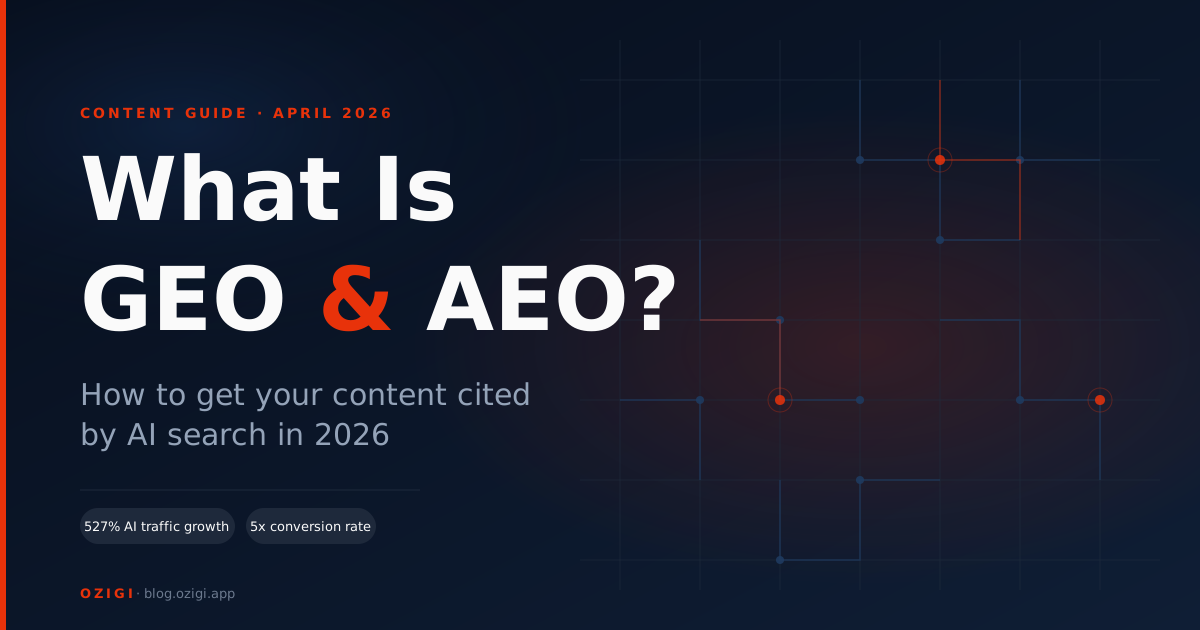
What Is GEO and AEO? How to Get Your Content Cited by AI Search in 2026

Founder and CEO of Ozigi. Writes about security, content strategy, and the tooling that small teams rely on.
Something changed in early 2025 that most bloggers and content teams missed entirely, including me.
organic traffic gotten from the traditional Google rankings started to flatten, but a different kind of referral was growing fast. The traffic coming in from ChatGPT, Perplexity, and Google's AI Overviews were converting at significantly higher rates than standard organic traffic as this started to signal trust and truth. In one documented B2B SaaS case study covering 42 websites, AI-referred traffic converted at 14.2% compared to 2.8% for traditional organic search. That's 5x in difference.
When I started building out the Ozigi blog, I made the mistake most new content teams make: I optimized purely for Google ranking because this is what my SEO training taught me. I would target keywords, write long-form content, build internal links, etc. Well, it worked...Partially. We got indexed, we started seeing impressions in Google's Search Console. But this wasn't the impact i was expecting with all the SEO effort being put in. The impressions simply were not converting, and when I searched for topics we had written about directly in ChatGPT or Perplexity, we were not cited anywhere.
That is when I went deep on GEO and AEO. This guide covers what I learned, what the research actually says, and the exact changes that move the needle.
What Is The Difference Between GEO And AEO In SEO?
These two terms are used interchangeably by most people, which creates confusion. They are related but not identical.
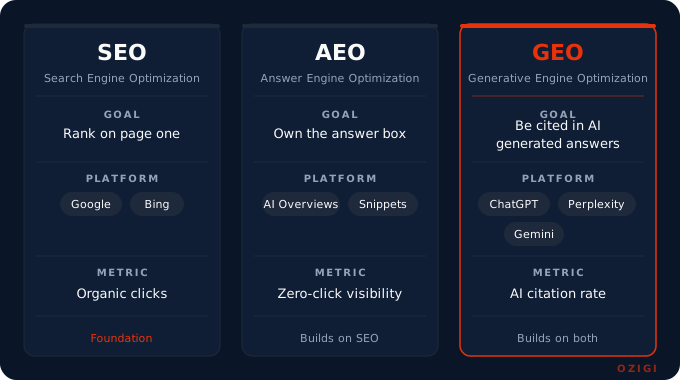
GEO (Generative Engine Optimization) is the practice of structuring your content so that large language models (ChatGPT, Perplexity, Google Gemini, Claude, Microsoft Copilot) cite or mention your content when generating answers to user queries. The term was coined in a 2024 academic paper published at ACM SIGKDD by researchers from Princeton, Georgia Tech, IIT Delhi, and the Allen Institute for AI.
AEO (Answer Engine Optimization) focuses specifically on getting your content surfaced as direct answers inside AI-driven interfaces: Google's AI Overviews, featured snippets, People Also Ask boxes, and voice search results.
The main difference: AEO is about owning the answer box. GEO is about being the source the AI trusts when it builds that answer. In 2026, you want both.
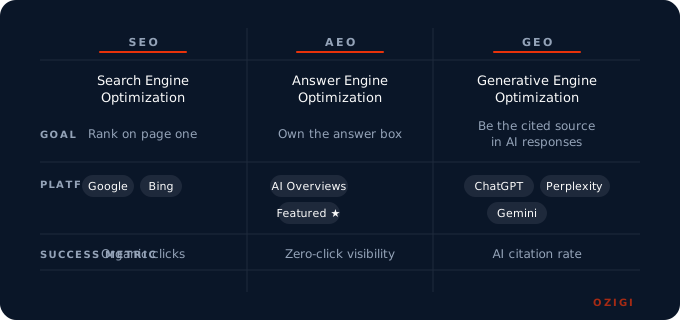
Traditional SEO asks: Can I rank on page one? AEO asks: Can I own the direct answer for this query? GEO asks: Will AI cite me as a trusted source when answering this question?
Why Does GEO And AEO Matter In 2026?
AI Overviews now appear in 25.11% of Google searches, up from 13.14% in March 2025, based on analysis of 21.9 million queries. Generative AI referral traffic is growing 165 times faster than organic search traffic. Ahrefs' February 2026 research found that AI Overviews now reduce organic click-through rates by 58%.
Put plainly: AI is answering more questions before users ever reach a website. If you are not being cited in those answers, you are invisible to a large and fast-growing segment of your potential readers.
The good news is that only 16% of brands are systematically tracking AI search performance, according to McKinsey (2025). The window for early-mover advantage is still open.
Stat to bookmark: AI-referred sessions jumped 527% year-over-year in the first five months of 2025, according to Previsible's 2025 AI Traffic Report.
How AI Search Engines Actually Choose What to Cite
This is the part most guides skip, and it is the most important.
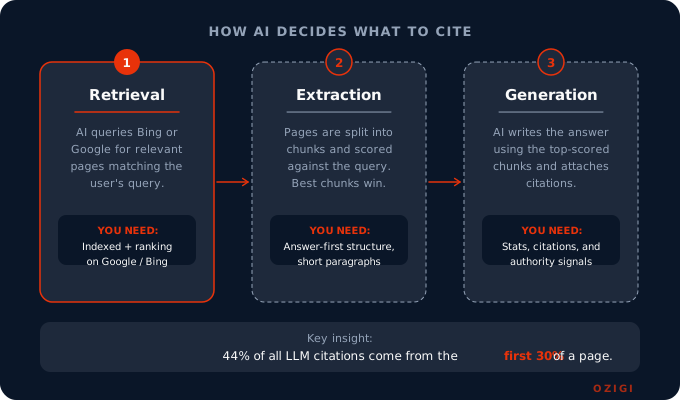
AI platforms do not retrieve your page the way Google does. They use a three-step process:
-
Retrieval: The model queries a web index (Bing for ChatGPT, Google for Gemini) to find relevant pages. If you are not indexed or your content does not match the query semantically, you never enter the process.
-
Extraction: Retrieved pages are split into chunks and scored against the user's question. Paragraphs that stand alone and contain direct, clear claims win here.
-
Generation: The model writes an answer using the highest-scoring chunks and cites the sources.
The implication of this is that 44% of all LLM citations come from the first 30% of a page's content, according to Seer Interactive's analysis. If your answer is buried in paragraph 14, you are not getting cited.
Additionally, Superlines' research found that AI platforms look for consensus signals. That is, your brand appearing consistently across Reddit discussions, industry publications, YouTube, and your own website, all with similar positioning. If you only exist on your own domain with minimal external validation, AI systems treat your claims with skepticism.
Does GEO Replace Traditional SEO?
No. And anyone telling you otherwise is selling something.
Strong Google rankings remain foundational because every URL surfaced in an LLM response is pulled from a live search index. Google's AI Overviews pull roughly 40% of their citations from content ranking in the top 10 organic results. SEO gets you indexed and trusted. GEO and AEO get you cited once you are.
Think of it as three layers:
- SEO gets your content found and indexed
- AEO structures your content to be extracted as direct answers
- GEO builds enough authority and presence that AI platforms trust and cite you consistently
The most efficient approach is to build content that serves all three simultaneously rather than creating separate strategies for each.
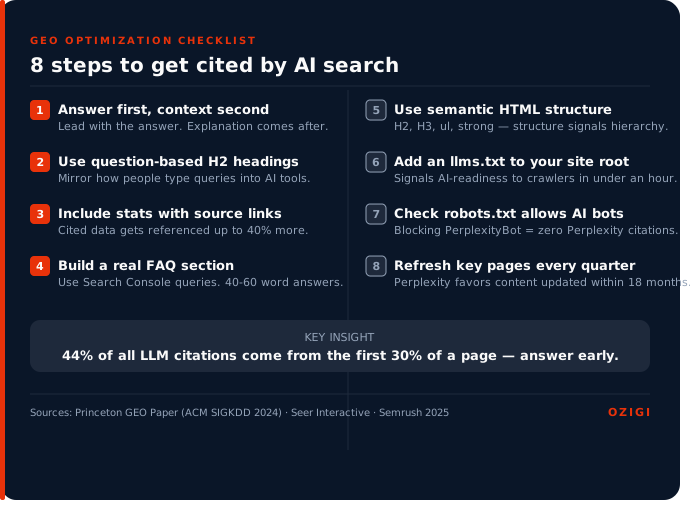
What Actually Gets You Cited: The Practical Checklist
These are drawn from the Princeton GEO research paper, Semrush's 2025 AI Overviews study, and Novara Labs' GEO optimization guide.
1. Answer First, Context Second
Most marketing content follows: context, buildup, answer. AI engines want the opposite: answer, then evidence, then context. Lead every section with one to two sentences that directly answer the heading. Put the explanation after.
When I restructured three Ozigi blog posts this way, our Search Console impressions on conversational queries increased within two weeks, before any other changes.
2. Use Question-Based Headings Throughout
Structure your H2s and H3s as questions people actually type. Instead of "Our Approach to Content Strategy," write "How Do You Optimize Blog Content for AI Search?" AI engines match headings to user queries directly. This is how Semrush structures their own content. They appear consistently in AI-generated answers because their section headers align with real queries.
3. Include Verifiable Statistics and Cite Your Sources
Content with statistics and source citations gets cited up to 40% more than unoptimized content, based on the Princeton GEO paper's findings. Vague claims get ignored. Specific, attributable data gets extracted and cited. Every stat in this article links back to its original source for exactly this reason.
4. Build a Real FAQ Section
Use Google Search Console to find the natural-language queries your content already gets impressions for. Those are the exact questions people are typing into AI tools. Build your FAQ around them with short, precise answers (40 to 60 words per answer) which are easiest for AI to extract and reproduce.
5. Use Proper Semantic HTML Structure
Apply H2, H3, <ul>, <strong>, and a consistent heading hierarchy throughout. AI crawlers parse semantic structure to understand content hierarchy and emphasis. A wall of text with no structure gets deprioritized at the extraction stage regardless of how good the content is.
6. Add an llms.txt File to Your Site
Adding an llms.txt file to your root directory signals AI-readiness to crawlers and gives models a structured overview of your site's content. Novara Labs has a practical implementation guide that takes under an hour to complete.
7. Check Your robots.txt Is Not Blocking AI Crawlers
Perplexity uses its own crawler (PerplexityBot). If your robots.txt accidentally blocks it, you will never appear in Perplexity results regardless of your content quality. Check your server logs or Perplexity's bot documentation to verify access is open.
8. Keep Key Pages Fresh
Perplexity retrieves sources in real time on every query and favors content published or updated within the last 6 to 18 months for time-sensitive topics. Refreshing a key article every quarter by updating statistics, expanding the FAQ, adding recent examples, etc, is enough to maintain citation eligibility.
How ChatGPT and Perplexity Differ in Citing (And Why It Changes Your Approach)
These two platforms are not the same optimization target.
ChatGPT uses Bing's web index when browsing is enabled. Setting up Bing Webmaster Tools and submitting your sitemap there directly improves your ChatGPT citation probability. ChatGPT cites a smaller number of sources per answer and is more selective.
Perplexity runs its own real-time crawler and retrieves sources fresh for every query. This means content changes can impact Perplexity citations relatively quickly. Perplexity cites more sources per answer, surfaces Reddit and community content heavily, and strongly favors structured headers that mirror the query wording.
For most blogs starting this process, Perplexity is the more immediately actionable target. Optimize for it first while building longer-term authority for ChatGPT.
Building Online Presence Beyond Your Own Domain/Brand
This is where GEO diverges most sharply from traditional SEO.
Reddit, LinkedIn, and YouTube ranked among the most-referenced domains by major LLMs in late 2025, according to analysis of LLM citation patterns. AI systems look for your brand or ideas appearing consistently across multiple independent sources before recommending you confidently.
Practical steps:
- Answer questions genuinely in relevant Reddit communities. Not promotional, not dropping blog links. Give actual helpful answers that establish your expertise.
- Submit content to platforms like Indie Hackers, developer newsletters, and niche community spaces where your audience already asks questions.
- A short YouTube video complementing each major article, with chapter markers and a transcript on the page, gives AI systems an additional citation source for the same topic.
None of this requires a large existing audience. It requires consistent presence in the places AI systems already mine for authoritative answers.
How to Measure Your GEO and AEO Performance
You cannot improve what you cannot see. These are three things you need to setup to monitor your GEO and SEO performance:
GA4 AI traffic channel grouping —> Create a custom channel that buckets referrals from chatgpt.com, perplexity.ai, and other AI platforms above the generic "Referral" bucket. Compare sessions, engaged sessions, and conversion rates against organic search. Search Engine Land's guide on segmenting LLM traffic in GA4 walks through the setup step by step.
Manual prompt monitoring —> Once a week, run your target queries directly in ChatGPT, Perplexity, and Google AI Overviews. Note whether you are cited, which URL appears, and who else appears. Log it in a spreadsheet with a date column. Over 30 days, patterns become obvious.
Google Search Console long-tail queries —> Filter for queries with six or more words. Growth in these conversational queries signals you are aligning with how people phrase questions in AI tools. This is free data that most content teams ignore entirely.
A Note on Ozigi
One thing I ran into consistently while building the Ozigi blog was this: producing structured, question-aligned, AI-ready content consistently is hard to do at speed. You already know what the structure should look like, but executing it across every article, every week, without slipping into generic long-form that nobody cites is the real work unless you have a strong team or agency.
Ozigi is what we built to address that problem directly. If you are generating long-form content for a blog and want it structured for both Google and AI citation from the start, it is worth a look. We are still building in public, and feedback from people who are actually trying to rank in this landscape shapes what we build next.
Frequently Asked Questions
What is the difference between SEO, AEO, and GEO? SEO optimizes pages to rank in traditional search results. AEO structures content to appear as direct answers in AI-driven interfaces like Google's AI Overviews and featured snippets. GEO focuses on being cited by large language models like ChatGPT and Perplexity when they generate answers. All three work together. SEO is the foundation, AEO and GEO build on top of it.
Does GEO replace traditional SEO in 2026? No. Strong Google rankings remain foundational because AI platforms pull citations from web indexes. Nearly 40% of Google's AI Overview citations come from top-10 organic results. GEO and AEO expand your strategy, they do not replace it.
How do I know if ChatGPT or Perplexity is citing my content? Run your target queries manually in both platforms and check for your domain in the citations. For tracking at scale, tools like Profound and AthenaHQ monitor brand mentions across AI platforms automatically.
What is llms.txt and do I need it? An llms.txt file sits at your site's root directory and signals AI-readiness to crawlers, giving language models a structured map of your content. It is not mandatory, but it removes friction for AI systems trying to understand your site. Implementation takes under an hour.
How often should I update content for GEO? For high-value pages, review and refresh every quarter. Update statistics, expand the FAQ section, and add recent examples. Perplexity favors content updated within the last 6 to 18 months for time-sensitive topics, so visible freshness directly improves citation chances.
Is AI search traffic actually worth optimizing for right now? Yes, if you care about conversion quality. AI-referred traffic converts at 4 to 5 times the rate of standard organic traffic across multiple documented case studies. The volume is smaller than Google organic today, but growing at 165 times the rate of traditional search traffic.
What content format gets cited most by AI engines? Short paragraphs (2 to 3 lines), question-based headings, direct-answer structure (answer before context), comparison tables, and FAQ sections. Content with verifiable statistics and cited sources gets cited up to 40% more than unoptimized content, based on the Princeton GEO research.
What does AEO stand for? AEO stands for Answer Engine Optimization. It is the practice of structuring content so that AI-powered search tools — Google's AI Overviews, ChatGPT, Perplexity — can extract and surface it as a direct answer to user queries, rather than just returning your page as a ranked link.
Building a blog and trying to figure out what actually gets cited in AI search? Drop your questions in the comments or reach out on hello@ozigi.app. We are running these experiments on the Ozigi blog in real time and will update this guide as results come in.
About the author
Founder and CEO of Ozigi. Writes about security, content strategy, and the tooling that small teams rely on.