What Is the Best Free GTM Tool in 2026 for Leads, Outreach, and Content?

Founder and CEO of Ozigi. Writes about go-to-market, content strategy, and the tooling small teams rely on.
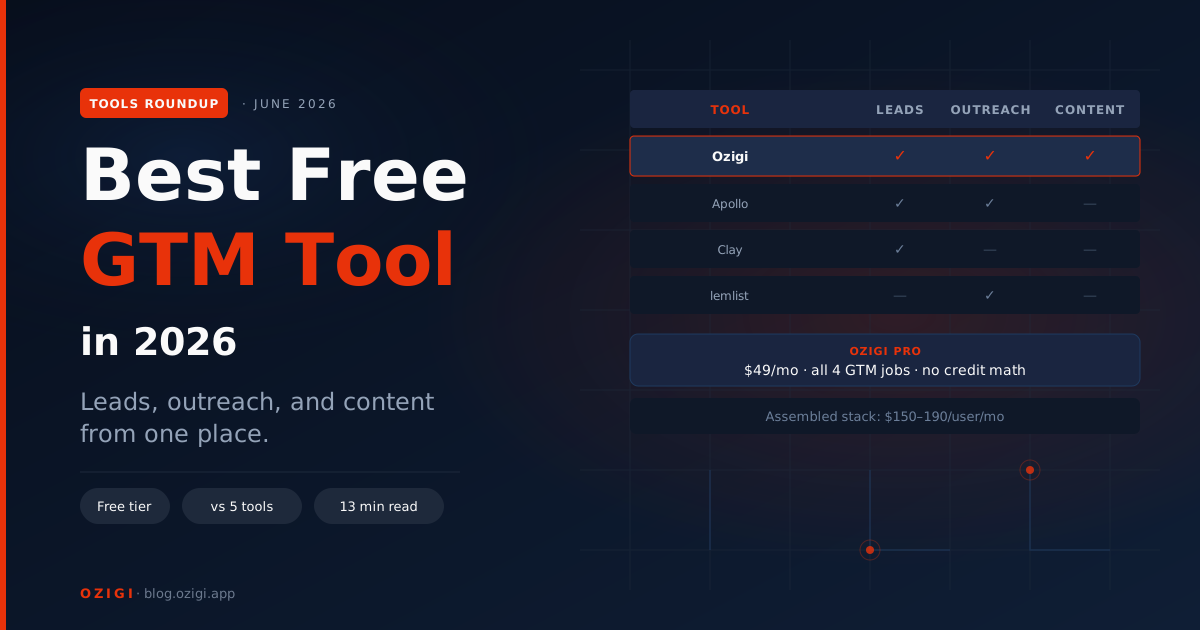
TL;DR: There is no single "best" GTM tool, but there is a best fit per budget and motion. Apollo owns the contact database. Clay owns enrichment workflows. lemlist, Instantly, and Smartlead own cold email sending. None of them write the blog post, the newsletter, or the social content that warms your market before the outreach ever lands. Ozigi runs the full motion in one place: it sources leads from GitHub, Dev.to, and LinkedIn, scores each one against your ICP with Gemini, runs persona-driven email and LinkedIn sequences that do not read like AI, syncs to your CRM, and writes your long-form and social content with the same engine. It starts free with no credit card, and the Pro plan runs both engines with no limits for $49 a month, less than a single seat of most multichannel senders. For a solo founder or a small technical team, that combination is hard to beat in 2026.
Most go-to-market tools solve one slice of the problem and charge you like they solve all of it.
You buy a data tool to find leads. You buy a sender to run sequences. You buy a writing tool to produce the content that builds trust before any of those emails arrive. Three subscriptions, three logins, three bills, and the cold email still sounds like a template because the writing tool and the sending tool never talk to each other.
That gap is the reason we built the GTM module inside Ozigi, on top of the content engine we already ran. This article is an honest look at where each major tool leads, where it loses, and why a suite that handles finding, qualifying, reaching out, and content creation now makes sense for a specific kind of team. I will name the cases where Apollo, Clay, or lemlist is still the right call, because pretending otherwise would waste your time.
What Counts as a GTM Tool in 2026, and Why Do Teams Pay for Three of Them?
A go-to-market tool helps you find the right people, reach them, and give them a reason to care. In practice that breaks into four jobs: sourcing leads, qualifying them against your ideal customer profile, running outreach, and producing the content that builds credibility around the outreach.
The market sells these as separate categories. Data platforms like Apollo and ZoomInfo own sourcing. Enrichment platforms like Clay own qualification and data cleanup. Sequencers like lemlist, Instantly, and Smartlead own sending. Writing tools like Jasper and Copy.ai own content.
A small team that wants the full motion ends up assembling three or four of these. The combined bill climbs fast, and the handoffs between tools are where personalization quietly dies. Your writer never sees the lead data. Your sender never sees your brand voice. The result is outreach that is technically personalized and emotionally generic.
What Is the Best Free GTM Tool in 2026?
For a solo founder or a small technical team that needs leads, outreach, and content from one place, Ozigi is the strongest free option in 2026. It is the only tool in this comparison whose free tier runs real outbound, lead scoring, and content from one login.
The honest qualifier: "best" depends on your motion.
- If you need the widest contact database and your buyers are non-technical, Apollo's free plan plus its 275M-plus contact pool is more complete than Ozigi's developer-first sourcing.
- If your whole job is enrichment at scale across dozens of data providers, Clay's free tier and workflow engine go deeper than Ozigi on pure data.
- If you only send cold email at high volume and never touch content, Instantly or Smartlead give you unlimited mailboxes for a flat fee.
- If you want all four GTM jobs in one tool, in your own voice, for free or close to it, Ozigi is the standout.
The rest of this article shows the math behind each of those calls. If you would rather watch the motion run than read about it, the live GTM demo walks through sourcing, scoring, and sending end to end.
| What you need | Best free or low-cost pick | Why |
|---|---|---|
| Full GTM motion in one tool | Ozigi | Sourcing, ICP scoring, email and LinkedIn sequences, CRM sync, and content from one place |
| Largest B2B contact database | Apollo | 275M-plus contacts, free plan with basic sequences |
| Deep enrichment workflows | Clay | 150-plus data providers, spreadsheet-style automation |
| High-volume cold email only | Instantly or Smartlead | Unlimited mailboxes, flat-fee sending |
| Multichannel sending with a built-in database | lemlist | Email plus LinkedIn, 450M contacts, per-seat |
Why Is Ozigi a Full GTM Suite and Not Just a Content Tool?
Ozigi started as a content engine, so this is a fair question. The answer is that the GTM module does the parts of go-to-market that come before and around content, and it shares the same writing engine.
Here is the full motion Ozigi runs inside one campaign:
- Sourcing. It pulls leads from GitHub, Dev.to, and LinkedIn based on the ICP you define: job titles, industries, company sizes, keywords, locations, and seniority.
- Qualification. Gemini scores every sourced lead against your ICP on a 0.0 to 1.0 scale, so only qualified prospects enter your sequence.
- Enrichment. When a GitHub profile hides its email, Ozigi mines the public commit history for a real address, then pulls bio, company, location, and topic tags.
- Outreach. It runs multi-step email and LinkedIn sequences from your own sending account, on a delay schedule you control, with daily limits that protect deliverability.
- CRM sync. Leads push to HubSpot, Zoho, or Salesforce on first contact, through a Composio connection.
- Content. The same content engine writes the blog posts, newsletters, and social content that warm the audience your outreach is trying to reach.
That last point is the difference. A cold email lands better when the recipient has already seen your name on a useful post. Ozigi is the only tool here that produces both halves of that motion with one persona voice. You can see how the pieces fit together in the architecture overview.
How Does Ozigi Find and Qualify Leads?
Ozigi sources from public developer platforms and scores leads with AI, then bills both steps as a single flat credit. You define the ICP once when you create a campaign, and the campaign sources and scores against it.
The sourcing logic is deliberate. GitHub and Dev.to are where technical buyers, maintainers, and DevRel-minded founders are already public about what they build. Ozigi searches those profiles, extracts the people who match your keywords, and enriches what it finds. For LinkedIn, a separate worker handles search using your own session.
Scoring matters as much as sourcing. A raw list of 200 GitHub users is noise. Ozigi sends each lead's bio, company, and tags to Gemini and asks for a match score against your ICP, then only the qualified leads move into the sequence. You are not paying to enrich people who were never a fit.
The trade-off is honest: this is developer-first sourcing. If your ICP is a CFO at a mid-market manufacturer, GitHub will not find them, and Apollo's database will. Ozigi is built for technical and creator-led go-to-market, not for every vertical on earth.
How Does Ozigi Run Cold Outreach Without Sounding Like AI?
Ozigi composes each outreach message from the lead's actual profile and your persona voice, then strips generic AI vocabulary at the engine level. The same Banned Lexicon that keeps Ozigi's blog content human applies to cold email, and we wrote up how the validator works in production if you want the engineering detail.
Most AI cold email reads like AI cold email. It opens with a flattering line about the company, pivots to a generic value claim, and closes with a calendar link. Recipients pattern-match it in two seconds and delete it.
Ozigi takes a different route. The composer writes a short intro for step one, a follow-up for step two, and a breakup for step three, each grounded in the lead's bio, company, and topics, and shaped by the persona you set on the campaign. The instruction to the model is blunt: short paragraphs, plain conversational tone, no corporate fluff. Every message carries a one-click unsubscribe, and replies are detected automatically so the sequence stops the moment someone answers.
This is the payoff of building outreach next to a content engine. The writing discipline that took us a year to get right for blog posts, documented in our note on keeping a human in the loop, now runs on your cold email too.
How Do Ozigi's Pricing Plans Work?
Ozigi splits pricing by which engine you use, so you only pay for the half you need, and the top plan runs both with no limits for $49 a month. There is a permanent free tier with no credit card.
One credit equals one lead sourced and scored, bundled into a single charge. Here is the structure (see full pricing for the current details):
| Plan | Price | Built for | Headline limits |
|---|---|---|---|
| Free | $0, no card | Trying both engines | 50 lead credits/mo, 1 campaign, 30 email sends/mo (no LinkedIn), reply detection, 3 content pieces/mo, 1 persona |
| Starter | $19/mo | Content only | 30 content campaigns/mo, unlimited personas, all publishing, image generation, newsletter sending (500/mo), scheduling. No outbound |
| Growth | $29/mo | GTM only | 1,000 credits/mo, unlimited campaigns and sends, LinkedIn outreach, CRM sync, reply detection, 10 content pieces/mo, 2 personas |
| Pro | $49/mo | Both engines | Unlimited credits, sequences, and content; unlimited personas and image generation; long-form; Ozigi Copilot; campaign analytics |
| Enterprise | Custom | Volume teams | Everything in Pro, custom volume, dedicated onboarding, SLA, roadmap input |
The split is the point. A content marketer who never sends cold email pays $19 and ignores the credit system entirely. A founder running outbound who only needs enough content to keep the pipeline warm pays $29 for unlimited sends plus 1,000 qualified leads a month. The team that wants both halves working together pays $49 for everything, uncapped.
How Much Does Ozigi Cost Compared to Apollo, Clay, and lemlist?
Ozigi is the cheapest way to run the full motion, and Pro at $49 a month undercuts a single seat of most multichannel senders while adding a content engine they do not have.
Here is the comparison, with vendor pricing verified as of late May 2026. Confirm current numbers on each vendor's own page before you buy, since GTM pricing changes often.
| Tool | Entry price | What that buys | Content included? |
|---|---|---|---|
| Ozigi Free | $0, no card | 50 lead credits, 1 campaign, 30 email sends, reply detection, 3 content pieces | Yes |
| Ozigi Growth | $29/mo | GTM only: 1,000 credits, unlimited sends, LinkedIn, CRM sync, 10 content pieces | Some |
| Ozigi Pro | $49/mo | Both engines, unlimited: credits, sequences, content, long-form, Copilot, analytics | Yes |
| Apollo | Free, then $49 to $119/user/mo annual (pricing) | Contact database and sequences, billed by credits | No |
| Clay | Free, then $185/mo Launch (pricing) | Enrichment workflows, billed by data credits and actions | No |
| lemlist | $59 to $159/seat/mo (pricing) | Email, then multichannel email plus LinkedIn, 450M database | No |
| Instantly / Smartlead | About $30 to $94/mo | Flat-fee cold email, unlimited mailboxes | No |
The pattern is clear. Every paid alternative covers one or two of the four GTM jobs and none of them write your content. A lean assembled stack, say Apollo Basic at $49 plus a multichannel sender plus a writing tool, lands near $150 to $190 per user per month before credit overages, based on published 2026 lemlist pricing and Apollo pricing breakdowns. Ozigi Pro covers all four jobs, with no caps, for $49.
Worth bookmarking: Apollo and Clay bill on variable credits, where a single contact can cost one credit for an email, several for a phone number, and more for enrichment, and failed lookups still draw down your balance, per Clay pricing breakdowns published in 2026. Ozigi uses one flat credit per qualified lead, gives you 50 free a month, and removes the cap entirely on Pro, so your bill does not spike with usage.
Is Apollo a Better GTM Tool Than Ozigi?
For raw contact data on non-technical buyers, yes. For an affordable end-to-end motion that includes content, no.
Apollo's strength is the database. It carries hundreds of millions of contacts, a free plan that actually runs basic sequences, and a strong reputation for sales intelligence. If you sell into broad B2B verticals and need phone numbers and firmographics at volume, Apollo is the category default, and its free tier is more useful than most.
The cost lives in the credit system. Apollo prices data by credits, where email reveals, phone numbers, and enrichment each consume a different amount, so heavy outbound teams routinely spend well past the $49 to $119 sticker once overages hit, as documented in multiple 2026 Apollo pricing reviews. There is also no content layer. Apollo finds and sequences. It does not write your blog or newsletter.
Choose Apollo if: you need the widest contact database, your buyers are not on GitHub, and content lives elsewhere in your stack. Choose Ozigi if: your ICP is technical or creator-led and you want outreach and content in one voice without credit math.
Is Clay Worth $185 a Month for Enrichment?
Clay is worth it if enrichment at scale is your actual job and you have someone to build the workflows. For a small team that wants leads, sending, and content, it is the wrong shape and the wrong price.
Clay is the most capable enrichment and workflow engine in this group. It aggregates 150-plus data providers into a spreadsheet-style interface, so you can chain lookups, waterfall through sources, and personalize at the row level. After its March 2026 pricing change, the entry paid plan, Launch, is $185 a month, and Growth is $495, with a free tier capped near 100 credits a month.
The catch is what Clay is not. It enriches and automates data; it does not send your sequences for you the way a dedicated sender does, and it does not write content. It also charges for failed lookups, which surprises teams when low-quality input lists burn credits with nothing to show. Clay is a power tool for revenue operations specialists, not an all-in-one for a founder doing everything.
Choose Clay if: enrichment is the core of your motion and you have the technical resources to run it. Choose Ozigi if: you want sourcing, scoring, sending, and content without building and maintaining workflows.
Are Instantly, Smartlead, and lemlist Better for Cold Email?
For high-volume cold email as a standalone job, Instantly and Smartlead are excellent and often cheaper at scale. lemlist is the strongest if you want email plus LinkedIn with a built-in database. None of them touch content.
Instantly and Smartlead both run flat-fee pricing with unlimited mailboxes, which is why agencies and high-volume senders favor them. Entry plans sit roughly between $30 and $94 a month depending on tier, and both lean hard into deliverability infrastructure and inbox rotation.
lemlist is multichannel and per-seat. Email Pro is around $59 a seat, Multichannel Expert around $99, and Outreach Scale around $159, with a 450M contact database bundled into the higher tiers. A five-person team on the multichannel plan runs close to $495 a month before add-ons, which is where per-seat pricing starts to hurt.
All three are sending specialists. They will out-send Ozigi at industrial volume. What they will not do is find your leads from developer platforms, score them with AI, or write the content that makes the cold email land warmer. If you want a sense of how Ozigi handles the social half of that, the Ozigi versus Hootsuite, Buffer, and SocialBee comparison goes deeper.
Choose a dedicated sender if: cold email volume is your entire motion and you handle data and content elsewhere. Choose Ozigi if: you want sending to share a brain with your sourcing and your content.
When Should You Not Choose Ozigi?
Honesty keeps this useful. There are clear cases where another tool wins, and you should know them before you switch.
- Your buyers are not technical. Ozigi sources from GitHub, Dev.to, and LinkedIn. If your ICP never appears on developer platforms, Apollo or ZoomInfo will find them and Ozigi will not.
- You run industrial-volume cold email. If you send tens of thousands of emails a week across hundreds of mailboxes, Instantly and Smartlead are purpose-built for that and Ozigi is not.
- Enrichment is your core product. If your team lives in waterfall enrichment across many providers, Clay's depth is worth its price.
- You need a large database of phone numbers. Ozigi focuses on email and LinkedIn outreach, not dialer-driven sales.
For everyone else, a technical founder, a DevRel team, an indie maker, a small B2B team selling to people who write code or read developer content, the all-in-one shape and the free starting price are the reason Ozigi exists.
How Do You Test Ozigi as a GTM Tool in 15 Minutes?
You can run the full motion on the free tier without a credit card. Here is the fastest way to judge it for yourself.
- Open ozigi.app and create a campaign. No card required.
- Describe your ICP in plain language: the job titles, keywords, and company sizes you sell to.
- Pick your sources, GitHub and Dev.to to start, and let Ozigi source and score leads against that ICP.
- Review the scored leads, then generate the step-one outreach email and read it aloud.
- In a second tab, generate a short blog post or repurpose an existing video into social posts with the same persona.
Read both the email and the post out loud. If they sound like one person wrote them, that is the suite working as designed. Then count the filler words: "delve," "robust," "leverage," "seamless." Ozigi's output should have none, because the engine is forbidden from using them. For the content side specifically, our comparison with Jasper, Copy.ai, and Writesonic runs the same read-aloud test.
Frequently Asked Questions
What is the best free GTM tool in 2026? For a small technical team that needs leads, outreach, and content together, Ozigi is the strongest free option. Its free tier runs 50 scored leads, 30 email sends, reply detection, and 3 content pieces a month with no credit card. Apollo's free plan is better only if you need a broad contact database.
Is Ozigi actually free, or is it a trial? Ozigi has a permanent free tier, not just a trial. It includes 50 lead credits a month, one active campaign, email sequences, and X, LinkedIn, and Discord publishing, with no credit card required. Paid plans start at $19 a month for content only or $29 for outbound only.
How much does Ozigi cost to run both leads and content? The Pro plan is $49 a month and runs both engines with no limits: unlimited credits, sequences, content, long-form, image generation, Copilot, and analytics. That is less than a single seat of most multichannel senders, which do not include content at all.
How is Ozigi different from Apollo or Clay? Apollo is a contact database with sequencing. Clay is an enrichment and workflow engine. Both bill by variable credits and neither writes content. Ozigi sources and scores leads, runs the outreach, and writes your blog and social content in one voice, with flat per-lead credits and a free starting tier.
Does Ozigi write cold emails that do not sound like AI? Yes. Ozigi composes each message from the lead's real profile and your persona voice, then strips generic AI vocabulary at the engine level using its Banned Lexicon. The instruction is short paragraphs, plain tone, and no corporate fluff. Every email includes a one-click unsubscribe and reply detection.
Where does Ozigi find leads? Ozigi sources leads from GitHub, Dev.to, and LinkedIn based on the ICP you define. When a GitHub profile hides its email, Ozigi mines the public commit history for a real address. This makes it strong for technical and creator-led ICPs and weaker for non-technical verticals.
Can Ozigi send to my CRM? Yes, on the Growth and Pro plans. Ozigi connects to HubSpot, Zoho, and Salesforce through Composio, and leads sync automatically on first contact. This keeps your pipeline in the CRM your team already uses while Ozigi handles sourcing, scoring, sending, and content upstream.
Is Ozigi better than lemlist for cold email? For pure high-volume cold email, dedicated senders like lemlist, Instantly, and Smartlead send more at scale. Ozigi wins when you want outreach to share one engine with your lead sourcing and your content, so the cold email and the blog post sound like the same person, at a far lower starting cost.
Sources and Further Reading
Vendor pricing pages, for current numbers:
- Apollo pricing: apollo.io/pricing
- Clay pricing: clay.com/pricing
- lemlist pricing: lemlist.com/pricing
- Instantly pricing: instantly.ai/pricing
- Smartlead pricing: smartlead.ai/pricing
Independent 2026 pricing breakdowns referenced in this article:
- Apollo: CloudTalk's 2026 Apollo pricing guide and Landbase's Apollo breakdown
- Clay: Landbase's Clay breakdown and Cleanlist on Clay's March 2026 pricing change
- lemlist: Astra GTM's 2026 lemlist pricing guide
Related Ozigi reading:
- What is GEO and AEO, and how to get cited by AI search in 2026
- Stopping AI slop in production: the Banned Lexicon validator
- Ozigi vs Jasper, Copy.ai, and Writesonic for longform
- How to make your LinkedIn content stand out in 2026
Pricing for Apollo, Clay, lemlist, Instantly, and Smartlead was verified against public 2026 pricing pages and breakdowns as of late May 2026 and is subject to change; check each vendor's site for current numbers. This article was drafted and refined on Ozigi, with the Banned Lexicon applied throughout. Running a go-to-market motion as a small team and want to compare notes? Reach out at hello@ozigi.app. Try the free tools before you commit: cold email generator, LinkedIn outreach generator, long-form article generator, and newsletter generator — no signup required for any of them.
About the author
Founder and CEO of Ozigi. Writes about go-to-market, content strategy, and the tooling small teams rely on.