
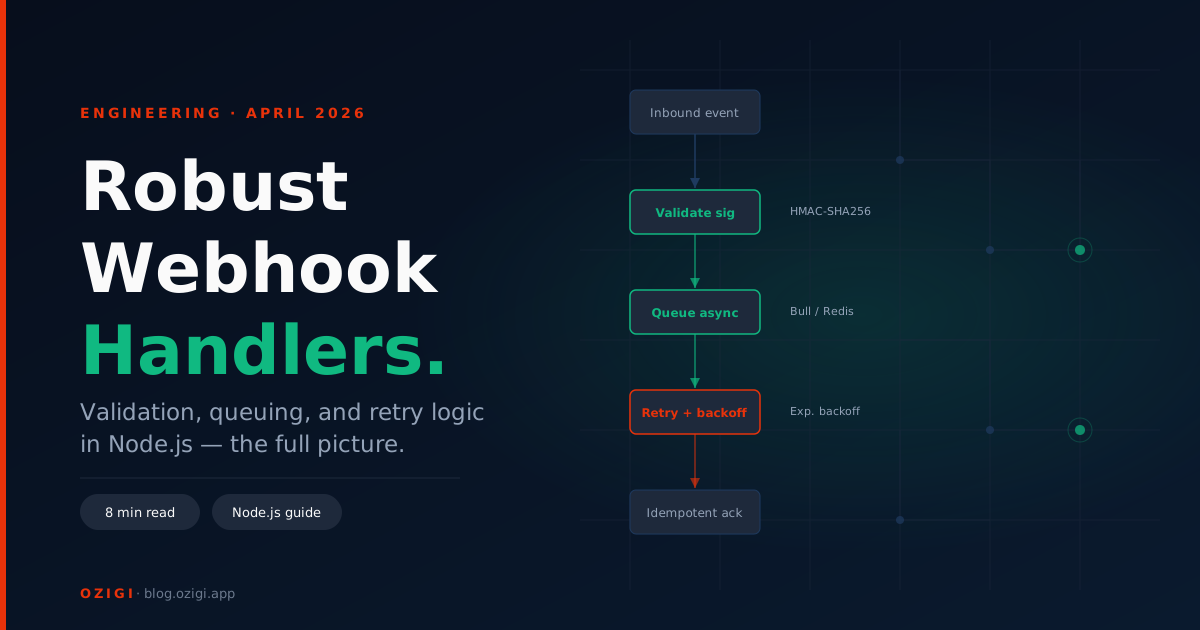
Building a Robust Webhook Handler in Node.js: Validation, Queuing, and Retry Logic

Founder and CEO of Ozigi. Writes about content strategy and the architecture of AI tools for technical creators.
Webhooks are everywhere. Stripe fires one when a payment succeeds. GitHub fires one when a PR is merged. Twilio fires one when an SMS lands. And when your handler is flaky — when it misses events, fails silently, or chokes under load — you lose data and trust.
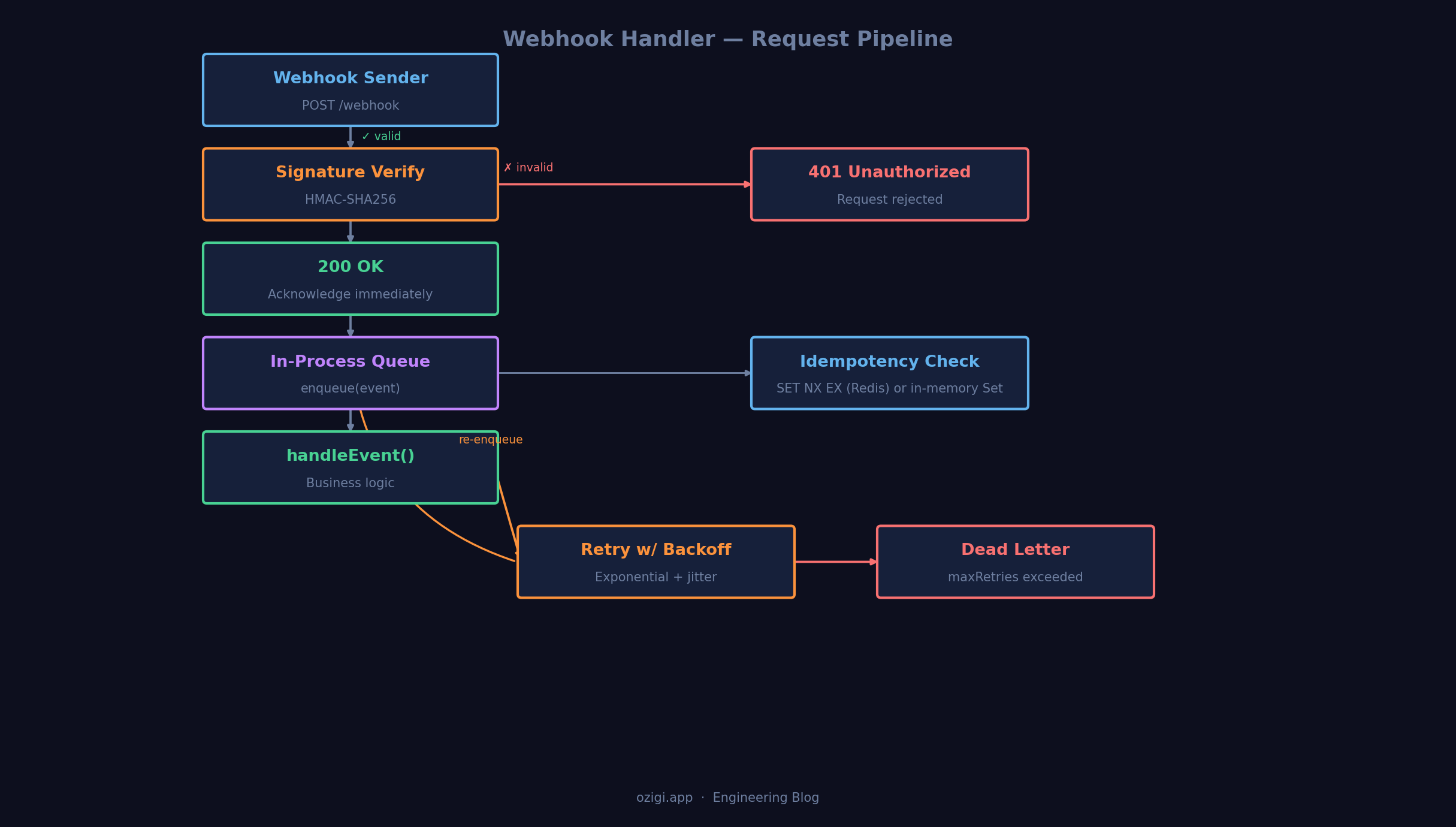
Most tutorials show you how to receive a webhook. Few show you how to handle it properly. This article covers the full picture: signature validation, idempotency, async queuing, and retry logic with exponential backoff.
We'll use Node.js and Express throughout, with no external queue infrastructure required. One important caveat up front: the queuing approach in this article is designed for a single, long-lived Node.js process. If you're running on serverless functions (Lambda, Cloud Run) or horizontally scaled deployments with multiple instances, in-memory queues are not reliable — skip ahead to the When to Upgrade section for the right tool in those cases.
TL;DR Summary
| Concern | Solution |
|---|---|
| Fake webhook senders | HMAC-SHA256 signature verification with timingSafeEqual |
| Slow handlers timing out | Acknowledge 200 immediately, process async |
| Cascading failures | In-process queue with concurrency limit |
| Transient errors | Exponential backoff with jitter |
| Duplicate events | Idempotency keys via Set or Redis |
What We're Building
A webhook handler that:
- Validates the request signature (so only legitimate senders get through)
- Acknowledges fast (returns
200immediately, does the work async) - Queues events in-process so the work doesn't block the HTTP layer
- Retries failures with exponential backoff
- Handles duplicates with idempotency keys
Step 1: Signature Validation
Never trust an incoming webhook without verifying it came from who you think it came from. Most webhook providers (Stripe, GitHub, Shopify) sign their payloads using HMAC-SHA256 with a shared secret.
jsconst crypto = require('crypto');

function verifySignature(payload, signature, secret) {
  const expected = crypto
    .createHmac('sha256', secret)
    .update(payload, 'utf8')
    .digest('hex');

  // Use timingSafeEqual to prevent timing attacks
  const expectedBuffer = Buffer.from(`sha256=${expected}`, 'utf8');
  const signatureBuffer = Buffer.from(signature, 'utf8');

  if (expectedBuffer.length !== signatureBuffer.length) return false;

  return crypto.timingSafeEqual(expectedBuffer, signatureBuffer);
}
Why timingSafeEqual? A simple === check leaks timing information — an attacker can brute-force signatures by measuring how long the comparison takes. timingSafeEqual always takes the same amount of time regardless of where the strings differ.
Now wire it into Express. A critical detail: you need the raw body for HMAC validation, not the parsed JSON. Express's json() middleware strips the raw body by default — use express.raw() on the webhook route instead.
jsconst express = require('express');
const app = express();

// Store raw body before parsing
app.use('/webhook', express.raw({ type: 'application/json' }));

app.post('/webhook', (req, res) => {
  const signature = req.headers['x-hub-signature-256']; // GitHub format
  const rawBody = req.body; // Buffer, because of express.raw()

  if (!verifySignature(rawBody, signature, process.env.WEBHOOK_SECRET)) {
    return res.status(401).json({ error: 'Invalid signature' });
  }

  const event = JSON.parse(rawBody);

  // Acknowledge immediately — do the work async
  res.status(200).send('OK');

  queue.enqueue(event);
});
The key discipline here: acknowledge before you process. If your business logic takes 2 seconds and the sender has a 1-second timeout, you'll get duplicate events.
Step 2: An In-Process Job Queue
You don't always need Redis or BullMQ for a job queue. For a single, persistent Node.js process, an in-process queue with controlled concurrency is enough — and it's simpler to reason about.
⚠️ Limitations to understand before using this pattern:
- Jobs are lost on restart. If your process crashes or is redeployed while events are queued, those jobs disappear silently. There is no persistence.
- Not shared across instances. If you run multiple server instances (behind a load balancer, in a cluster, or in any horizontally scaled setup), each instance has its own queue. Events are not distributed or deduplicated across them.
If either of those constraints is a problem for your use case, go straight to a real queue like BullMQ or AWS SQS.
jsclass WebhookQueue {
  constructor({ concurrency = 3, maxRetries = 5 } = {}) {
    this.queue = [];
    this.running = 0;
    this.concurrency = concurrency;
    this.maxRetries = maxRetries;
  }

  enqueue(event) {
    this.queue.push({ event, attempts: 0 });
    this.drain();
  }

  drain() {
    while (this.running < this.concurrency && this.queue.length > 0) {
      const job = this.queue.shift();
      this.running++;
      this.process(job).finally(() => {
        this.running--;
        this.drain(); // pick up the next job
      });
    }
  }

  async process(job) {
    try {
      await handleEvent(job.event);
    } catch (err) {
      job.attempts++;
      if (job.attempts < this.maxRetries) {
        const delay = this.backoff(job.attempts);
        console.warn(`Retrying event ${job.event.id} in ${delay}ms (attempt ${job.attempts})`);
        setTimeout(() => {
          this.queue.push(job);
          this.drain();
        }, delay);
      } else {
        console.error(`Event ${job.event.id} failed after ${this.maxRetries} attempts`, err);
        // Send to dead-letter store, alert, etc.
      }
    }
  }

  backoff(attempt) {
    // Exponential backoff with jitter
    const base = Math.min(1000 * 2 ** attempt, 30000);
    const jitter = Math.random() * 1000;
    return base + jitter;
  }
}

const queue = new WebhookQueue({ concurrency: 3, maxRetries: 5 });
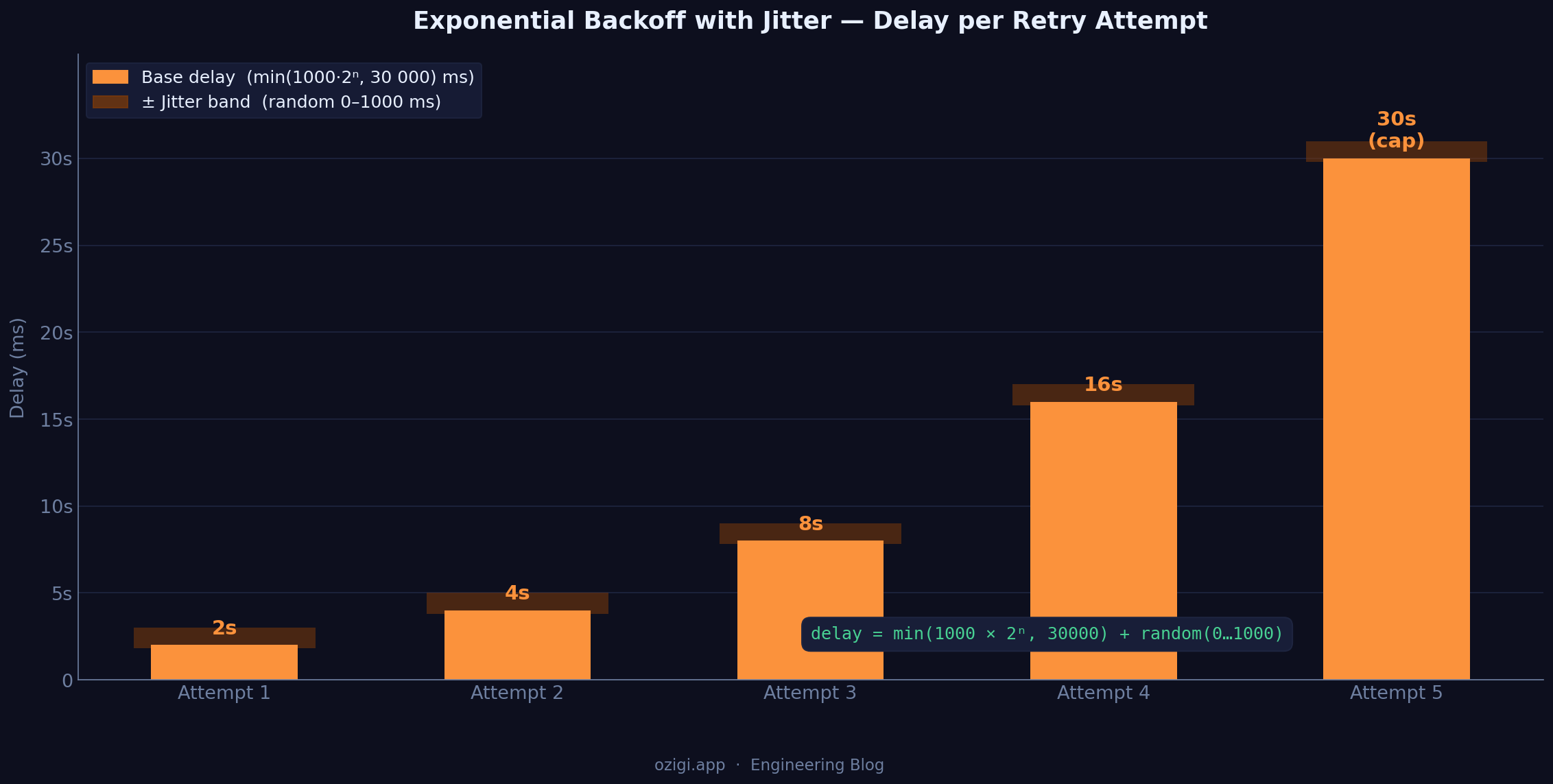
The backoff method uses exponential backoff with jitter. Without jitter, all retrying jobs fire at the same moment and create a thundering herd. Adding a random jitter spreads the load. See AWS's writeup on backoff and jitter for a deeper look at why this matters at scale.
Step 3: The Event Handler
This is where your actual business logic lives. Keep it focused — one function per event type.
jsasync function handleEvent(event) {
  switch (event.type) {
    case 'payment.succeeded':
      await handlePaymentSucceeded(event.data);
      break;
    case 'user.created':
      await handleUserCreated(event.data);
      break;
    default:
      console.log(`Unhandled event type: ${event.type}`);
  }
}

async function handlePaymentSucceeded(data) {
  // e.g., upgrade account, send receipt, update DB
  await db.orders.update({ id: data.orderId, status: 'paid' });
  await emailService.sendReceipt(data.customerEmail, data.amount);
}
Step 4: Idempotency
Webhook senders will send duplicates. Network timeouts, retries on their end, and at-least-once delivery guarantees mean you'll see the same event ID more than once.
Your handler needs to be idempotent — processing the same event twice should have the same effect as processing it once.
jsconst processedEvents = new Set(); // Use Redis in production

async function handleEvent(event) {
  if (processedEvents.has(event.id)) {
    console.log(`Skipping duplicate event: ${event.id}`);
    return;
  }

  processedEvents.add(event.id);

  switch (event.type) {
    // ... your handlers
  }
}
In production, replace the in-memory Set with a Redis SET NX EX call via ioredis so idempotency survives process restarts:
jsconst redis = require('ioredis');
const client = new redis();

async function isAlreadyProcessed(eventId) {
  // SET key value NX EX seconds
  // NX = only set if not exists; EX = expire after 24h
  const result = await client.set(`event:${eventId}`, '1', 'NX', 'EX', 86400);
  return result === null; // null means the key already existed
}

async function handleEvent(event) {
  if (await isAlreadyProcessed(event.id)) {
    return;
  }
  // process...
}
Step 5: Putting It All Together
jsconst express = require('express');
const crypto = require('crypto');

const app = express();
app.use('/webhook', express.raw({ type: 'application/json' }));

// --- Signature verification ---
function verifySignature(payload, signature, secret) {
  const expected = crypto
    .createHmac('sha256', secret)
    .update(payload)
    .digest('hex');
  const expectedBuffer = Buffer.from(`sha256=${expected}`);
  const sigBuffer = Buffer.from(signature);
  if (expectedBuffer.length !== sigBuffer.length) return false;
  return crypto.timingSafeEqual(expectedBuffer, sigBuffer);
}

// --- Queue ---
class WebhookQueue {
  constructor({ concurrency = 3, maxRetries = 5 } = {}) {
    this.queue = [];
    this.running = 0;
    this.concurrency = concurrency;
    this.maxRetries = maxRetries;
  }
  enqueue(event) { this.queue.push({ event, attempts: 0 }); this.drain(); }
  drain() {
    while (this.running < this.concurrency && this.queue.length > 0) {
      const job = this.queue.shift();
      this.running++;
      this.process(job).finally(() => { this.running--; this.drain(); });
    }
  }
  async process(job) {
    try {
      await handleEvent(job.event);
    } catch (err) {
      job.attempts++;
      if (job.attempts < this.maxRetries) {
        const delay = Math.min(1000 * 2 ** job.attempts, 30000) + Math.random() * 1000;
        setTimeout(() => { this.queue.push(job); this.drain(); }, delay);
      } else {
        console.error(`Dead letter: ${job.event.id}`, err);
      }
    }
  }
}

const queue = new WebhookQueue();

// --- Idempotency ---
const processed = new Set();

// --- Handler ---
async function handleEvent(event) {
  if (processed.has(event.id)) return;
  processed.add(event.id);
  console.log(`Processing event: ${event.type} (${event.id})`);
  // your business logic here
}

// --- Route ---
app.post('/webhook', (req, res) => {
  const sig = req.headers['x-hub-signature-256'];
  if (!verifySignature(req.body, sig, process.env.WEBHOOK_SECRET)) {
    return res.status(401).send('Unauthorized');
  }
  res.status(200).send('OK'); // acknowledge immediately
  queue.enqueue(JSON.parse(req.body));
});

app.listen(3000, () => console.log('Webhook server listening on :3000'));
When to Upgrade to a Real Queue
The in-process queue above is acceptable for a single persistent process with moderate throughput — think a low-traffic internal tool or a side project where restarts are rare and you run one instance. You'll want to graduate to BullMQ (Redis-backed) or AWS SQS when:
- You're running multiple server instances (in-process state won't be shared).
- You need event history and visibility into failed jobs.
- Your event volume exceeds a few hundred per minute consistently.
- You need scheduled retries that survive process restarts.
The good news: the handler logic above (handleEvent, idempotency, backoff) carries over directly. You're just swapping the queue substrate.
Webhooks are one of those things that look simple until they aren't. Getting these five concerns right means you can receive events reliably at scale — without losing data, without duplicating side effects, and without taking down your server under a burst of retries.
If you're building something that relies on real-time event delivery, these patterns are worth getting right from the start.
What's your webhook setup look like? Drop a comment — especially if you've found a gotcha I haven't covered.
Since you're here: Ozigi also ships a handful of free, no-signup tools — a free cold email generator, a free LinkedIn outreach generator, a free long-form article generator, and a free newsletter generator. Worth a look if any of that's useful to you.
About the author
Founder and CEO of Ozigi. Writes about content strategy and the architecture of AI tools for technical creators.
Read more like this
Demystifying RAG Architecture for Enterprise Data: A Technical Blueprint
Apr 09, 2026
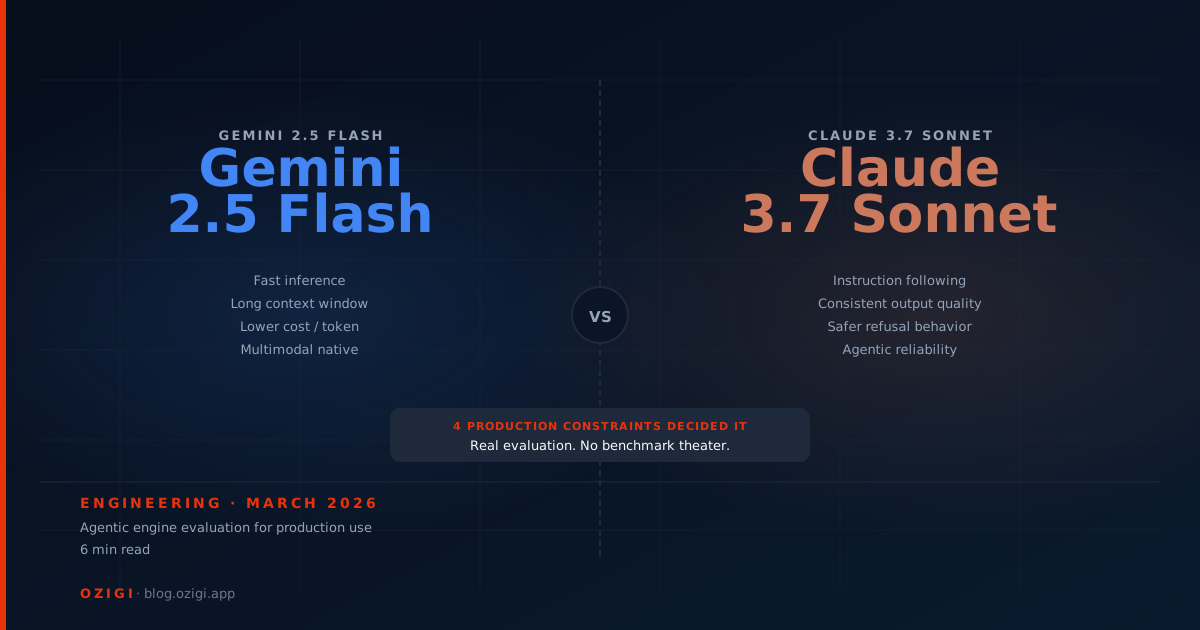
Gemini 2.5 Flash vs Claude 3.7 Sonnet: 4 Production Constraints That Made the Decision for Me
Mar 10, 2026
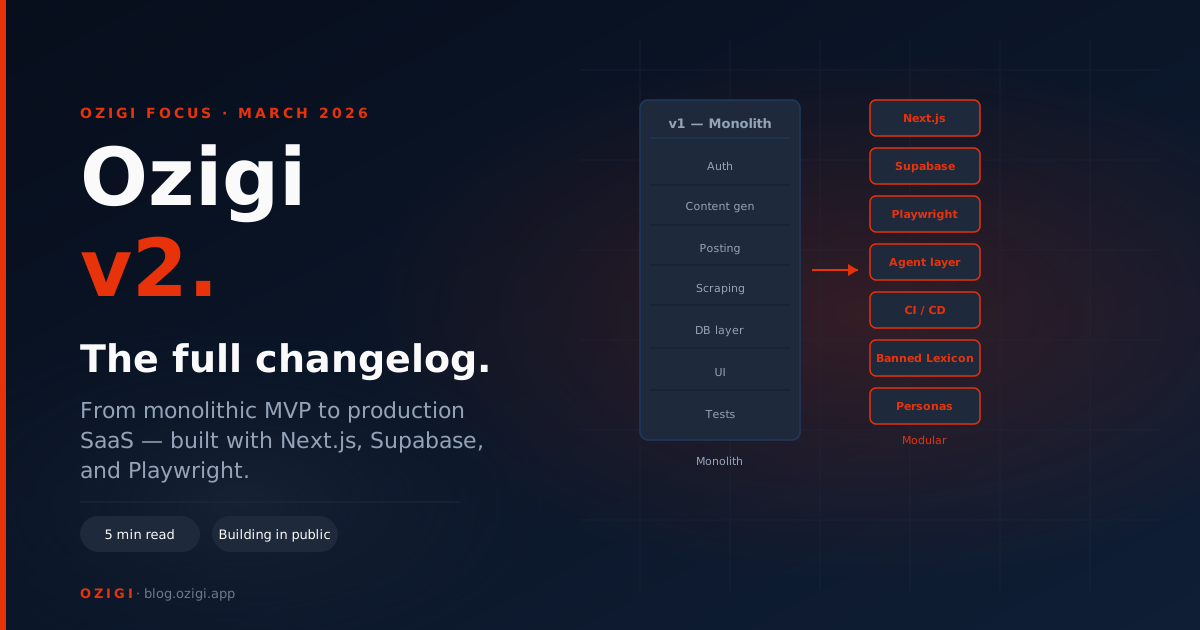
Ozigi v2 Changelog: Building a Modular Agentic Content Engine with Next.js, Supabase, and Playwright
Mar 02, 2026