Demystifying RAG Architecture for Enterprise Data: A Technical Blueprint

Founder and CEO of Ozigi. Writes about content strategy and the architecture of AI tools for technical creators.
The advent of Large Language Models (LLMs) has ushered in a new era of AI-powered applications, promising to revolutionize how enterprises interact with information, automate tasks, and generate insights. From crafting marketing copy to summarizing complex legal documents, the capabilities of models like OpenAI's GPT series, Anthropic's Claude, and Meta's Llama have captured the imagination of developers and business leaders alike.
However, the path from impressive public demos to practical, production-ready enterprise solutions is fraught with challenges. While LLMs excel at general knowledge tasks, their utility often diminishes when confronted with an organization's most valuable asset: its proprietary data.
This is where Retrieval-Augmented Generation (RAG) architecture emerges as a critical enabler. RAG provides a robust, scalable, and cost-effective framework for connecting the immense generative power of LLMs with the specific, dynamic, and often sensitive knowledge locked within an enterprise's data silos. It addresses the inherent limitations of standalone LLMs, transforming them from general-purpose conversationalists into domain-specific experts.
This article serves as a comprehensive technical blueprint for software engineers, data engineers, and technical product managers looking to build sophisticated AI features leveraging LLMs with private enterprise data. We will dissect the core problems LLMs face in an enterprise context, introduce the RAG paradigm, and meticulously walk through its three-step pipeline: ingestion and chunking, storage and semantic search, and context-aware generation. We'll also explore common pitfalls and provide actionable insights to ensure your RAG implementation is not just functional, but performant and reliable. By the end, you'll have a clear understanding of how to engineer a RAG solution that empowers your LLMs to speak with authority, accuracy, and relevance on your enterprise's terms.
The Problem with Standalone LLMs
Before diving into the solution, it's crucial to understand the fundamental limitations that prevent standard, off-the-shelf LLMs from being directly applicable to most enterprise use cases without significant augmentation.
The Knowledge Cutoff Problem
Large Language Models are trained on vast datasets of publicly available text and code. This training process is computationally intensive and takes a significant amount of time, meaning that once a model is released, its knowledge base is inherently static. This creates what's known as a knowledge cutoff. For example, an LLM released in early 2023 would have no inherent knowledge of events, products, or company policies that emerged later that year or in 2024.
For enterprise applications, this limitation is critical. Organizations operate in dynamic environments where information changes constantly. An LLM relying solely on its pre-trained knowledge cannot answer questions like:
- "What was our Q2 revenue performance for the current fiscal year?"
- "What is the latest iteration of our employee expense policy?"
- "Which customer accounts are currently in our new pilot program?"
- "What are the technical specifications of our newly released product version 3.1?"
These are questions that demand real-time, proprietary, and often granular data. A standalone LLM, without external context, simply doesn't have access to this information, rendering it largely ineffective for internal business intelligence or operational support.
The Hallucination Risk
Perhaps even more concerning than a lack of knowledge is the phenomenon of hallucination. LLMs are sophisticated pattern-matching machines, not factual databases. They are designed to predict the most statistically probable next token based on their training data. When an LLM encounters a query about information it doesn't possess, especially if the query's structure is similar to questions it can answer, it doesn't respond with "I don't know." Instead, it confidently generates plausible-sounding but entirely fabricated information.
In an enterprise context, hallucinations are not merely an inconvenience; they pose significant risks:
- Misinformation and Bad Decisions: An LLM providing incorrect financial figures, outdated compliance advice, or non-existent product features can lead to flawed business strategies, operational errors, and reputational damage.
- Erosion of Trust: If users repeatedly receive inaccurate information, their trust in the AI system, and by extension, the underlying business process, will quickly diminish.
- Legal and Compliance Exposure: In regulated industries, incorrect AI-generated responses could lead to severe compliance violations, legal liabilities, and financial penalties.
- Security Risks: While less direct, a hallucinating LLM might inadvertently reveal sensitive patterns or generate seemingly innocuous but misleading data that could be exploited.
The core issue is that LLMs are trained to be generative, not necessarily truthful. They prioritize fluency and coherence over factual accuracy when lacking concrete information. This fundamental characteristic makes them unsuitable for direct deployment on proprietary tasks without a mechanism to ground their responses in verifiable, up-to-date data. This mechanism is precisely what Retrieval-Augmented Generation provides.
What is Retrieval-Augmented Generation (RAG)?
Retrieval-Augmented Generation (RAG) is an architectural pattern designed to bridge the gap between the powerful generative capabilities of LLMs and the need for factual accuracy, recency, and domain-specificity in enterprise applications. At its heart, RAG is about providing an LLM with external, relevant, and verifiable information at the time of inference, allowing it to generate responses that are grounded in truth rather than relying solely on its pre-trained, potentially outdated, or irrelevant knowledge.
Think of RAG as giving an LLM an "open-book test." Instead of expecting the AI to answer purely from memory (its training data), we equip it with the ability to quickly look up the exact right documents or data snippets before formulating its answer. This fundamentally changes the LLM's role from a knowledge memorizer to a sophisticated knowledge synthesizer.
The Core Principle: Separate Retrieval from Generation
The genius of RAG lies in its modular approach. It separates the challenge of finding relevant information from the challenge of generating a coherent, human-like response. This separation offers several key advantages:
- Factuality: By providing specific, up-to-date context, RAG significantly reduces the likelihood of hallucinations, as the LLM is instructed to base its answer only on the provided information.
- Recency: New information can be added to the external knowledge base in real-time, without needing to retrain or fine-tune the LLM. This makes RAG highly agile for dynamic enterprise data.
- Domain Specificity: The external knowledge base can be tailored precisely to an organization's proprietary data, enabling LLMs to become experts in niche domains where they previously had no knowledge.
- Cost-Effectiveness: RAG is generally far more cost-effective than repeatedly fine-tuning LLMs for new or updated information. Fine-tuning is expensive, time-consuming, and can lead to 'catastrophic forgetting' of general knowledge. RAG simply updates the knowledge base.
- Interpretability/Attribution: Because the LLM's response is grounded in retrieved documents, it's often possible to cite the sources, improving trust and auditability.
In essence, RAG transforms an LLM from a general-purpose oracle into a highly specialized, context-aware agent capable of interacting intelligently with an organization's most critical information assets. It allows enterprises to leverage the cutting-edge of generative AI without compromising on accuracy, relevance, or control over their data.
The Core RAG Architecture (The 3-Step Pipeline)
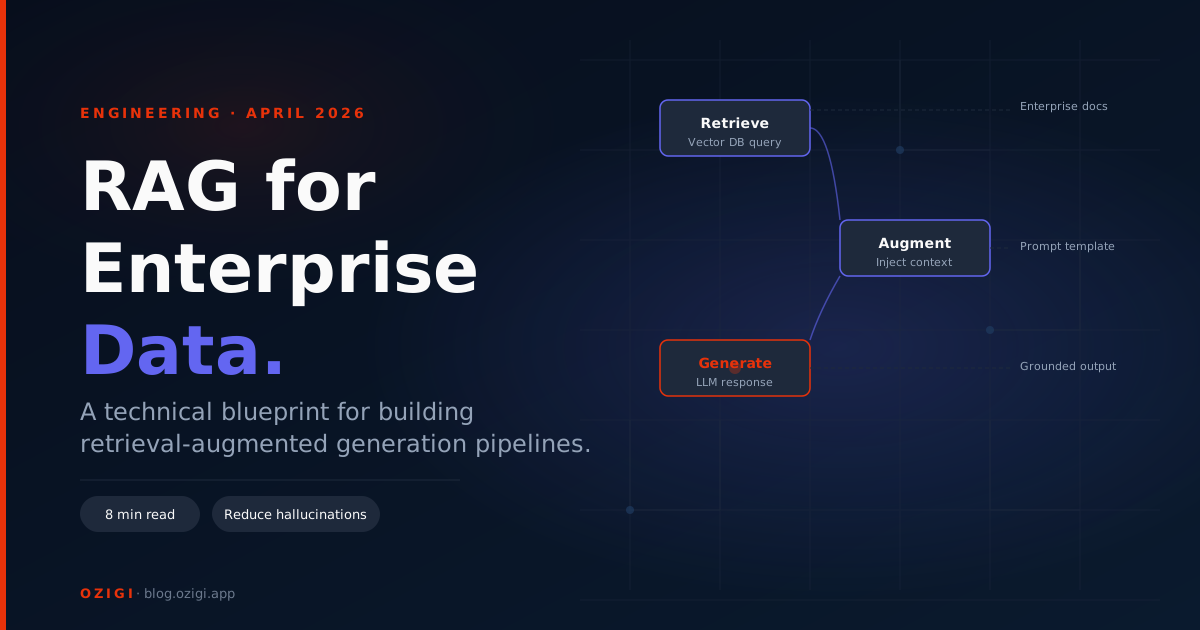
Building a robust RAG system involves a sequential, multi-component pipeline. While implementations can vary in complexity, the core architecture typically comprises three distinct, yet interconnected, stages:
- Ingestion & Chunking: Preparing your enterprise data for retrieval.
- Storage & Semantic Search: Efficiently storing and retrieving relevant data.
- Generation (The Prompt Context): Using retrieved data to inform the LLM's response.
Let's visualize this flow: A user submits a query. This query is used to search a specialized knowledge base (often a vector database) for relevant information. The retrieved information, alongside the original query, is then sent to the LLM, which synthesizes a grounded answer. This process ensures the LLM is always operating with the most relevant and up-to-date context available.
Step 1: Ingestion & Chunking
This initial phase is critical for preparing your raw enterprise data for efficient retrieval. It involves extracting information from various sources, processing it, and transforming it into a format suitable for semantic search.
Data Sources & Preprocessing
Your enterprise data can reside in a multitude of formats and locations:
- Documents: PDFs, Word documents (.docx), Markdown files, HTML pages (e.g., Confluence, SharePoint).
- Databases: SQL databases, NoSQL databases (e.g., customer records, product catalogs).
- Communication Platforms: Slack archives, email threads, CRM notes.
- Code Repositories: Git repositories (for code documentation, internal libraries).
The first step is to extract the raw text content from these diverse sources. This often involves:
- Parsing: Using libraries (e.g.,
PyPDF2,python-docx,BeautifulSoup) to extract text from structured and semi-structured documents. - Optical Character Recognition (OCR): For scanned PDFs or image-based documents, OCR tools are essential to convert images of text into machine-readable text.
- Cleaning: Removing boilerplate text (headers, footers, navigation), irrelevant metadata, excessive whitespace, or corrupted characters.
- Standardization: Converting all text to a consistent encoding (e.g., UTF-8) and potentially normalizing capitalization or punctuation.
Chunking Strategy: Breaking Down Knowledge
LLMs have a finite context window – the maximum number of tokens they can process in a single prompt. Enterprise documents can be lengthy, far exceeding these limits. Moreover, sending an entire document for every query is inefficient and often introduces noise. Therefore, the extracted text needs to be broken down into smaller, manageable units called chunks.
Effective chunking is an art and a science. Poor chunking can lead to:
- Lost Context: If chunks are too small, essential information might be split across multiple chunks, making it difficult for the LLM to understand the complete picture.
- Irrelevant Information: If chunks are too large, they might contain a lot of irrelevant text, diluting the signal and potentially confusing the LLM.
Common chunking strategies include:
- Fixed-Size Chunking: Splitting text into chunks of a predefined character or token count (e.g., 500 characters) with a specified overlap (e.g., 50 characters). Overlap helps maintain context across chunk boundaries.
- Sentence/Paragraph Chunking: Splitting text at natural linguistic breaks (sentences, paragraphs). This often results in more semantically coherent chunks than fixed-size methods.
- Recursive Character Text Splitter: A common approach (found in libraries like LangChain) that attempts to split by paragraphs, then sentences, then words, until chunks fit a specified size, ensuring semantic boundaries are prioritized.
- Semantic Chunking: A more advanced technique where chunks are created based on semantic similarity. Text is embedded, and then a clustering algorithm or other method identifies natural breaks where the meaning shifts significantly.
Best Practice: Experiment with different chunk sizes and overlap values. A chunk size of 200-1000 tokens with 10-20% overlap is a common starting point, but the optimal values depend heavily on your specific data and use case.
Embedding Generation: The Language of Similarity
Once your data is chunked, the next crucial step is to transform each text chunk into a numerical representation called an embedding.
- What are Embeddings? Embeddings are high-dimensional vectors (lists of numbers, e.g., 1536 dimensions for models like OpenAI's text-embedding-3-small or open-source alternatives) that capture the semantic meaning of text. Texts with similar meanings will have vectors that are numerically 'close' to each other in this high-dimensional space.
- How they are Generated: An embedding model (e.g., OpenAI's text-embedding-3-small, various Sentence Transformers models from Hugging Face, Cohere Embed) takes a piece of text as input and outputs its corresponding vector.
- Importance: Embeddings are the backbone of semantic search. They allow us to move beyond keyword matching and find information based on conceptual similarity. For instance, a query about "remote work policy" could retrieve documents mentioning "telecommuting guidelines" because their embeddings are semantically close.
Each chunk of text from your enterprise data is processed by an embedding model, and its resulting vector is stored. This collection of vectors, along with references to their original text chunks, forms the core of your searchable knowledge base.
Step 2: Storage & Semantic Search (The Vector DB)
With your enterprise data processed into chunks and vectorized, the next step is to store these embeddings efficiently and enable rapid, accurate semantic search. This is the domain of the Vector Database.
The Role of a Vector Database
A vector database is purpose-built for storing, indexing, and querying high-dimensional vectors. Unlike traditional relational databases that excel at structured queries (e.g., SELECT * FROM users WHERE age > 30), vector databases specialize in 'similarity search' – finding vectors that are numerically closest to a given query vector.
How Semantic Search Works
When a user submits a query (e.g., "How do I request time off?"):
- Query Embedding: The user's query is first sent to the same embedding model that was used to embed your enterprise data chunks. This transforms the natural language query into a query vector.
- Vector Similarity Search: The query vector is then sent to the vector database. The database's indexing algorithms (e.g., Hierarchical Navigable Small Worlds (HNSW), Inverted File Index (IVF), Locality-Sensitive Hashing (LSH)) efficiently compare the query vector to all stored document chunk vectors.
- Distance Metrics: This comparison typically uses distance metrics like:
- Cosine Similarity: Measures the cosine of the angle between two vectors. A value of 1 indicates identical direction (perfect similarity), 0 indicates orthogonality (no similarity), and -1 indicates opposite direction.
- Euclidean Distance: Measures the straight-line distance between two points in Euclidean space. Smaller distance implies greater similarity. The vector database returns the 'top-K' most similar document chunk vectors, where 'K' is a configurable parameter (e.g., retrieve the 5 most relevant chunks).
- Retrieval of Original Text: Along with the similar vectors, the vector database also retrieves the original text content of the corresponding chunks.
Popular Vector Database Options
The choice of vector database depends on factors like scale, latency requirements, deployment model (managed vs. self-hosted), and ecosystem integration:
- Managed Services:
- Pinecone: A cloud-native, fully managed vector database known for its scalability and ease of use.
- Weaviate: An open-source, cloud-native vector database that also offers a managed service, supporting GraphQL and semantic search.
- Qdrant: Another open-source vector search engine, available as self-hosted or managed, known for its speed and advanced filtering capabilities.
- Self-Hosted/Open Source:
- Milvus: A widely adopted open-source vector database designed for massive-scale vector similarity search.
- Chroma: A lightweight, easy-to-use open-source embedding database, great for local development and smaller-scale applications.
- pgvector: An extension for PostgreSQL that enables efficient vector similarity search directly within a relational database. Excellent for scenarios where you want to keep your vector data alongside your existing structured data.
Advanced Retrieval Strategies
Simple top-K retrieval is a good start, but for complex enterprise data, more sophisticated strategies can enhance relevance:
- Re-ranking: After an initial retrieval of, say, 20 chunks, a smaller, more powerful re-ranking model (often a cross-encoder or a specialized LLM) can evaluate the relevance of these chunks more deeply against the query and re-order them, selecting the absolute best 'K' for the LLM.
- Hybrid Search: Combining semantic (vector) search with traditional keyword-based search (e.g., BM25) can provide a more robust retrieval system. Keyword search excels at finding exact matches or rare terms, while semantic search handles conceptual understanding.
- Multi-query Retrieval: Generating multiple slightly different queries from the original user query (e.g., using an LLM) and running parallel searches to broaden the retrieval scope.
- Contextual Compression: Filtering or summarizing retrieved documents to only include the most relevant sentences or paragraphs, reducing noise and optimizing token usage for the LLM.
Step 3: Generation (The Prompt Context)
This is the final stage where the LLM synthesizes an answer, critically informed by the context retrieved from your vector database.
Constructing the Augmented Prompt
The core idea here is to inject the retrieved document chunks directly into the LLM's prompt. This creates an 'augmented prompt' that provides the LLM with all the necessary information to answer the user's question accurately and without hallucination.
A typical augmented prompt structure looks like this:
python# Placeholder for a simplified LangChain-like RAG snippet

from langchain_core.prompts import ChatPromptTemplate
from langchain_core.runnables import RunnablePassthrough
from langchain_core.output_parsers import StrOutputParser
from langchain_core.documents import Document

# Initialize the LLM (using a sample configuration)
# from langchain_openai import ChatOpenAI
# llm = ChatOpenAI(model="gpt-4-turbo", temperature=0)

# A simple retriever mock for demonstration. In a real RAG system, this would
# embed the question, query a vector DB, and return Document objects.
class MockRetriever:
    def get_relevant_documents(self, query: str) -> list[Document]:
        # In a real scenario, this would query the vector DB
        if "remote work expenses" in query.lower():
            return [
                Document(page_content="The company's remote work expense policy allows reimbursement for internet and utilities up to $50/month."),
                Document(page_content="Employees must submit expense reports by the 15th of the following month for remote work related costs."),
            ]
        return [Document(page_content="No specific information found on that topic in the internal knowledge base.")]

mock_retriever = MockRetriever()

# 1. Define the prompt template
# This template instructs the LLM on its role and how to use the provided context.
template = """You are an expert assistant for a large enterprise.
Answer the user's question based *only* on the provided context.
If the answer cannot be found in the context, politely state that you do not have enough information.

Context:
{context}

Question:
{question}
"""
prompt = ChatPromptTemplate.from_template(template)

# 2. Format retrieved documents into a single context string
# This is crucial: the retriever returns Document objects, but the prompt expects a formatted string.
def format_docs(docs: list[Document]) -> str:
    """Serialize retrieved documents into a single context string."""
    return "\n\n".join(doc.page_content for doc in docs)

# 3. Define the RAG chain (using LangChain's Runnable interface for clarity)
# The 'context' key is populated by the retriever and formatted into a string,
# and 'question' by the user's input.
rag_chain = (
    {
        "context": lambda x: format_docs(mock_retriever.get_relevant_documents(x["question"])),
        "question": RunnablePassthrough()
    }
    | prompt
    | llm  # Your initialized LLM instance goes here (e.g., ChatOpenAI model above)
    | StrOutputParser()
)

# 4. Invoke the chain with a user query
# from langchain_openai import ChatOpenAI # Example LLM initialization
# llm = ChatOpenAI(model="gpt-4-turbo", temperature=0)
# response = rag_chain.invoke({"question": "What is the policy for remote work expenses?"})
# print(response)
# This would print: "The company's remote work expense policy allows reimbursement for internet and utilities up to $50/month. Employees must submit expense reports by the 15th of the following month for remote work related costs."
Key elements of the prompt template:
- System Message/Role: Sets the persona and instructions for the LLM (e.g., "You are an expert assistant...").
- Context Placeholder (
{context}): This is where the retrieved document chunks are inserted. It's crucial to clearly delineate the context from the actual question. - Instruction for Context Usage: Explicitly telling the LLM to only use the provided context and to state if the answer is not found is vital to prevent hallucination.
- Question Placeholder (
{question}): The user's original query.
LLM Interaction and Synthesis
Once the augmented prompt is constructed, it is sent to the chosen LLM (e.g., GPT-4 Turbo, Claude 3.5 Sonnet, or open-source alternatives like Llama 3). The LLM then processes this entire prompt, using the provided context to formulate a relevant and accurate answer. Because the context is explicitly given, the LLM acts more like a sophisticated summarizer and question-answering system over the provided text, rather than generating from its internal, general knowledge.
This final step ensures that the LLM's response is:
- Grounded: Directly supported by the retrieved enterprise data.
- Relevant: Addresses the user's specific query.
- Accurate: Minimizes hallucination by constraining the LLM's generation to the facts presented in the context.
By following this three-step pipeline, enterprises can transform generic LLMs into powerful, domain-specific AI assistants that deliver reliable and actionable intelligence from their most valuable data assets.
Common Pitfalls in RAG Engineering
While RAG offers a powerful solution, its effective implementation requires careful consideration and engineering rigor. Several common pitfalls can undermine the performance and reliability of a RAG system if not addressed proactively.
1. Suboptimal Chunking Strategies
As discussed, chunking is foundational, and mistakes here cascade through the entire pipeline:
- Chunks that are too small: If chunks are excessively granular (e.g., single sentences), they might lack sufficient context to be meaningful on their own. The semantic meaning required to answer a complex question could be fragmented across multiple disparate chunks, making retrieval difficult or incomplete.
- Chunks that are too large: Conversely, chunks that are too long introduce noise. They might contain a lot of irrelevant information alongside the relevant bits, diluting the signal for the embedding model and increasing the chances of retrieving less precise context. Large chunks also consume more tokens in the LLM's context window, increasing inference cost and potentially hitting context limits prematurely.
- Poor Overlap: Insufficient overlap between sequential chunks can lead to critical information being split precisely at the boundary, making it hard for retrieval to capture the complete idea.
Mitigation: Experimentation is key. Develop an evaluation pipeline to test different chunk sizes, overlap strategies, and chunking methods (e.g., fixed-size vs. recursive vs. semantic) against a diverse set of representative queries. Consider specialized chunking based on document structure (e.g., splitting by headings, sections in a PDF). For highly structured data, consider 'parent-child' or 'summary' chunking where smaller chunks are linked to larger, more contextual parent chunks or summaries for different retrieval stages.
2. Irrelevant or Insufficient Retrieval
Even with good chunking, the retriever component can fail to provide the LLM with the optimal context:
- Poor Embedding Model Choice: Not all embedding models are created equal, and some perform better on specific domains or languages. Using a generic embedding model for highly specialized enterprise terminology might lead to embeddings that don't accurately capture semantic similarity, resulting in irrelevant retrievals.
- Noisy or Low-Quality Data in Vector DB: If your ingested data contains outdated, contradictory, or simply poorly written information, the vector database will retrieve it, and the LLM will struggle to synthesize a coherent, accurate answer. 'Garbage in, garbage out' applies acutely here.
- Suboptimal
kValue: Retrieving too few chunks (kis too low) might mean missing critical pieces of information. Retrieving too many chunks (kis too high) introduces irrelevant information into the LLM's context, potentially confusing it or causing it to misinterpret the core question.
Mitigation:
- Embedding Model Evaluation: Test different embedding models for your specific domain. Consider fine-tuning an open-source embedding model on your proprietary data if off-the-shelf options underperform.
- Data Quality Management: Implement robust data cleansing, deduplication, and versioning strategies for your source documents. Only ingest high-quality, current, and relevant data into your RAG knowledge base.
- Advanced Retrieval Techniques: Employ re-ranking models to refine the initial top-K results. Utilize hybrid search (keyword + vector) to capture both exact matches and semantic similarity. Explore multi-query strategies to generate a more comprehensive set of retrieved documents.
3. Latency Issues
RAG introduces additional steps in the query processing pipeline, which can impact response times:
- Slow Query Embedding: Converting the user's query into a vector can take time, especially if the embedding model is large or running on under-provisioned hardware.
- Slow Vector Database Lookups: As the size of your vector database grows (millions or billions of vectors), similarity search can become a bottleneck if indexing is inefficient or the database is not properly scaled.
- LLM Inference Latency: Even with optimized context, the LLM's generation step can be slow, especially for larger, more capable models (e.g., GPT-4) or for very long responses.
Mitigation:
- Optimize Embedding Models: Choose embedding models that balance performance and accuracy. For query embedding, consider smaller, faster models if acceptable. Implement caching for frequently asked questions.
- Vector DB Optimization: Ensure your vector database is correctly indexed (e.g., using HNSW or IVF) and adequately resourced. Explore cloud-native managed vector databases that handle scalability automatically. Consider sharding your vector index for very large datasets.
- LLM Choice and Optimization: Select an LLM that meets your latency and quality requirements. For internal applications where cost and speed are paramount, smaller open-source models might be preferable to larger, more expensive cloud models. Implement streaming responses from the LLM where possible to improve perceived latency.
4. Prompt Engineering Failures
Even with perfect retrieval, a poorly constructed prompt can lead to suboptimal LLM responses:
- Vague or Ambiguous Instructions: If the prompt doesn't clearly define the LLM's role, desired output format, or constraints, the LLM might deviate from expectations.
- Failure to Constrain to Context: Forgetting to explicitly instruct the LLM to only use the provided context (e.g., "Answer only from the context provided. If the answer is not in the context, state that you don't know.") is a common mistake that reintroduces hallucination risk.
- Context Window Overflow: If the combined length of the prompt, retrieved chunks, and the expected response exceeds the LLM's maximum context window, the model will truncate the input, leading to incomplete or erroneous answers.
Mitigation:
- Clear and Concise System Prompts: Define the LLM's persona and task unambiguously. Use clear delimiters for context and questions.
- Explicit Guardrails: Always include instructions to strictly adhere to the provided context and to admit when information is not available.
- Dynamic Context Management: Implement logic to truncate or summarize retrieved chunks if their combined length approaches the LLM's context window limit. Prioritize the most relevant chunks in such scenarios. Evaluate the impact of different context lengths on LLM performance.
- Few-Shot Examples: For specific response formats or nuanced tasks, providing one or two examples within the prompt can guide the LLM more effectively.
Addressing these common pitfalls requires a holistic approach, combining careful data engineering, robust infrastructure, and iterative prompt design. Continuous monitoring and evaluation are essential to ensure your RAG system consistently delivers accurate and performant results.
Conclusion & Next Steps
The journey from generic LLMs to powerful, domain-specific AI applications for enterprise data is fundamentally paved by Retrieval-Augmented Generation. RAG architecture is not merely an enhancement; it is a transformative paradigm that addresses the core limitations of pre-trained LLMs – their knowledge cutoff and propensity for hallucination – making them truly viable for critical business functions.
By systematically ingesting and chunking proprietary data, transforming it into semantically rich embeddings, storing it in high-performance vector databases, and then intelligently augmenting LLM prompts with retrieved context, enterprises can unlock unprecedented capabilities. RAG offers a cost-effective, agile, and scalable alternative to expensive model fine-tuning, allowing organizations to keep their AI systems current with rapidly evolving internal knowledge.
This article has provided a comprehensive technical blueprint, detailing the motivations, core components, and common challenges in engineering a robust RAG pipeline. The principles outlined here – from meticulous data preparation and strategic chunking to efficient vector search and precise prompt engineering – are the bedrock of successful RAG implementations.
Ready to Build Your First RAG Application?
- Explore Frameworks: Dive into open-source frameworks like LangChain and LlamaIndex. These libraries provide high-level abstractions for building RAG pipelines, simplifying integration with various LLMs, embedding models, and vector databases.
- Experiment with Vector Databases: Set up a local instance of Chroma or pgvector to get hands-on experience, or explore managed services like Pinecone for scalability.
- Start Small, Iterate Fast: Begin with a small, manageable dataset from your enterprise. Focus on getting a basic RAG pipeline operational, then iteratively refine your chunking, retrieval, and prompt strategies based on real-world queries and evaluation metrics.
- Continuous Learning: The RAG landscape is evolving rapidly. Stay updated with the latest research in retrieval techniques, embedding models, and multi-modal RAG. Consider exploring advanced topics like agentic RAG, where LLMs can dynamically decide when and how to retrieve information.
RAG empowers you to transform LLMs from generalists into trusted, domain-expert collaborators, enabling your enterprise to harness the full potential of generative AI with confidence and accuracy. The future of enterprise AI is augmented, and RAG is your blueprint to building it.
Feedback & Community
We believe in transparent, community-driven content creation. This article was generated using the Ozigi Dashboard – our advanced longform content generation platform – and has been thoroughly reviewed and refined by our engineering team.
Have feedback on this article? We'd love to hear your thoughts:
- Leave a comment below or email us at hello@ozigi.app
- Share your RAG architecture experiences and learnings with our community
Interested in building your own enterprise AI content? Longform article generation is available to users on the Organization tier, limited to 5 articles per day. Check our pricing details to learn more about what Ozigi can do for your content strategy. Or try the free long-form article generator first — no signup required.
About the author
Founder and CEO of Ozigi. Writes about content strategy and the architecture of AI tools for technical creators.